• Home
  • About the Farm
  • How We Farm
  • Directions
  • What is CSA?
  • CSA & Farmers Market
  • Membership
  • FAQ
  • In Our Garden
  • Recipes
  • Veggie Lovers Say
  • About the Farmers
  • Farm Talk: Kim's Column
  • Kim's Writing
  • Farm in the News
  • Contact
Menu

Hillside Springs Farm

32 Comerford Rd
Westmoreland, NH, 03467
(603) 399-7288
HILLSIDE SPRINGS FARM

Your Custom Text Here

Hillside Springs Farm

  • Home
  • Farm
    • About the Farm
    • How We Farm
    • Directions
  • CSA
    • What is CSA?
    • CSA & Farmers Market
    • Membership
    • FAQ
  • Veggies
    • In Our Garden
    • Recipes
    • Veggie Lovers Say
  • Stories
    • About the Farmers
    • Farm Talk: Kim's Column
    • Kim's Writing
    • Farm in the News
  • Contact

December Pause

January 2, 2013 Kim Peavey

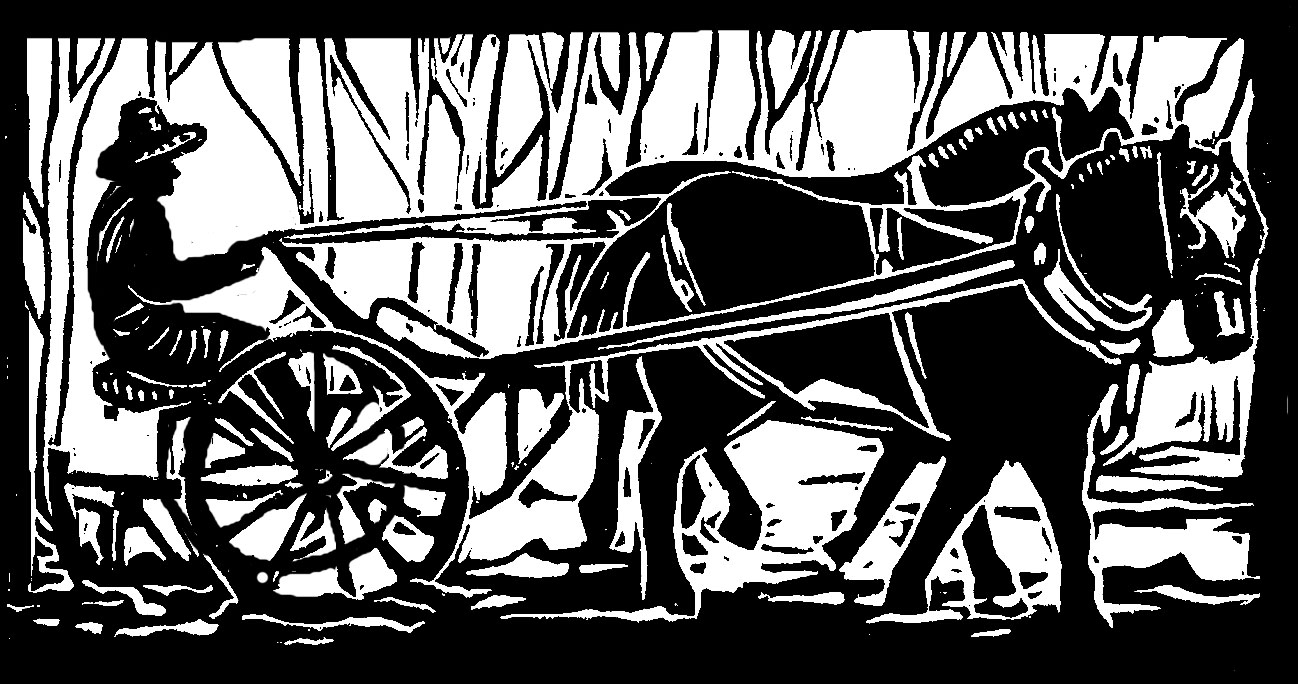
December is a restful month on our vegetable farm.  Sure, there’s lots of things to do yet: feed the four workhorses, three times a day; finish clearing out the two greenhouses; roll up the last of the irrigation hoses and the last of the row cover; fix everything that’s broken over the season; put away tools, machinery, harvest buckets, crates; catch up on office work.

But the long haul of the year is over, the pressure of regular planting, cultivating, harvesting, production, is over.  After nine months of unremitting farming, December lets us take a deep breath. 

Or at least my farming fellow does.  I have a harder time letting go of my lists.  Granted, I love to make lists, love to cross tasks off my lists, and I also love to make lists for other people, so that they too can have the wonderful pleasure of accomplishment.

Accordingly, I start my December day with a mental list: breakfast, morning writing, pay the bills, calculate just how much oof-we-don’t-want-to-but we-got-to off the farm work is necessary to make the rest of the winter’s budget.  Then sort the green tomatoes, cook the potatoes with problems, tuck the winter potatoes and carrots and beets into the root cellar.  And outside: put the honeybee equipment away, finish clearing the small greenhouse, get some more wood into the woodshed, reorganize the tool area, clean the horse stalls . . .

My list is always much longer than any possible day could contain, but hey!  It’s first thing in the morning!  What a day it could be!  What a day of accomplishment and crossing off of items! 

After breakfast for the horses and for us, I am still full of list enthusiasm, and I ask my farming fellow what his plans for the day are.

“Oh,” he answers, yawning, “ I don’t really like to have a plan for this time of year.”

I laugh.  “No, really,” I say.

“Well, I could make one, if you really want . . .”

“Yeah,” I answer, thinking of the nice list I could make for him.

“Well . . . I was thinking of washing the dishes this morning . . .” There is a long pause.  “And then there’s that music I want to go to in town tonight . . .”

I am smiling, letting the plan sink in.  I am smiling, and then laughing.  A lot.

“What?” he says.

“Here’s my plans,” I reel the list off.

“Wow,” he says.  “You’re going to do a lot.” 

“I might not get it all done,” I admit.  “I thought you might like to do some of it with me.”

He nods slowly.  “I might,” he says.  He picks up his book, puts his feet up on the couch.  “Ah, I love this time of year,” he says happily, “you work outside a little, you work inside a little, you read your book a little . . .”

Oh, I like this funny fellow, and his long pauses.  In fact, I like his pauses a lot better than my pauses.  My pauses are to come up with more work to do.  His pauses are to rest.  Yet if my fellow ever felt inclined to make a list, he would get as much or more crossed off it by the end of the day as I would on my list. 

Pause.  I watch the December farmer enjoying his book on the couch.

Pause.  Maybe it would be good to read my book for a little while, too?  Because it’s December.  December is a restful month on a vegetable farm.  Right? 

Pause.  And without rest, how can any kind of work, farming or otherwise, really be sustainable or green? 

Pause.  Exactly right!  And then there’s tomorrow, too.  Tomorrow we could cross lots of things off my nice list . . .

Originally published in the Monadnock Shopper News, Dec 26, 2012 – Jan 1, 2013
Tags Winter

Shiver, Whimper, Whine

December 5, 2012 Kim Peavey

For years I’ve shivered and shook and whimpered and whined about harvest days in November.  Oh, some of it is lovely: the gentle sorting of the onions, pulled weeks earlier, cured, and only needing a little tidying and arranging in the shed; the easy cutting of tender, brilliantly green heads of lettuce directly from the warm greenhouse; even harvesting the kale from the field, enjoying the quiet cool morning mist.  But what I dread in November is the Terrible Hour of the Washing-of-the-Roots.

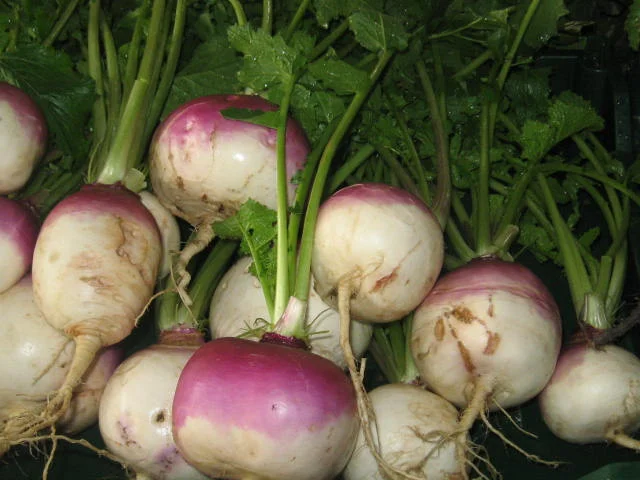
They are nice roots, in themselves, potatoes and carrots, rutabagas and purple top turnips, but they all come to the harvest shed covered in dirt.  Somehow this dirt must come off.  We are a relatively small CSA garden, compared to many farms; with just thirty members coming on each harvest day, we can’t really justify a fancy-dancy root washer.

What we have instead is the roots, the dirt, our hands, and several buckets of water.  Cold water.  Cold water in November.  Outside.  

We must begin: must plunge our hands in.  The shock travels up to the voice box:  “Aggh, aacck, aaagh,” I gasp.

In the cold, cold water, I wash, carrot by carrot, thirty pounds of carrots.  I wash thirty rutabagas, thirty turnips, daikon radishes.  Slowly the numbness begins, creeps up, up, up.    

“Wah,” I finally wail, “I can’t feel my fingers, I can’t feel my wrists, I can’t feel my elbows.  Is this a potato, or a rock?”My farming fellow says kindly, “It’s a rock, dear,” and cups my frozen fingers in his warm fresh-from-the-tropics-of-the-greenhouse hands.

“You poor dear,” he goes on, “I’ll finish it, why don’t you let me finish it?”  

”No, no,” I answer, “I’m almost done.”  I am down to the last ten pounds--half a five gallon bucket-- of my sixty pounds of potato by potato duty.

Suddenly the warms hands tighten on my cold ones.  My fellow’s eyes light up.  “I’ve got a brilliant idea! A fantastic idea!”

“Oh, yeah?” I say half-heartedly, and then, “Just don’t take your hands away,” clutching my stiff fingers around his, more interested in warmth than a brilliant, fantastic, and animated idea, complete with sweeping arm gestures.

“Let’s wash the roots in the house!  With warm water!”

“What?  In the house?” I am shocked.  This has never been done before!

It is revolutionary!  It is miraculous!  And it is incredible that we’ve never thought of such a thing, despite ten plus years of shivering, whimpering November harvests!

The very next harvest day, I am in the kitchen, filling my buckets of potatoes and carrots with lukewarm water.  I hear the hot water heater click on in the cellar.  Ooof.  Here I am using up fossil fuel, when really I could do this job outside with water straight from the hose.  Is this truly in keeping with our efforts at greenness?

But then I put my hands in the bucket.  Oh, it is marvelous.  I can feel the roots, I can feel my hands, I can even feel my brain, warm, thinking, not entirely consumed by whimpering and whining.

What I think about is this: another revolutionary miraculous idea, in another gardening year, about our greenhouse.  We start all our seeds in the propane-heated greenhouse in March, heating up an enormous amount of air to start tiny seeds.  But then my fellow had the brilliant idea of blocking off part of the structure with some old greenhouse plastic, thus cutting the area we had to heat during seedling season by two-thirds.  It was ingenious, and we couldn’t believe we hadn’t thought of it before. 

Now our greenhouse use is much more efficient, and, I cleverly work out with my warm brain, the fuel I’m using for this warm water in my buckets must be offset by our much-decreased use of fuel for the greenhouse!  In fact, our energy use is so offset that I take another bold step:  I turn on the radio!  Actually, not the radio, but I play a wonderful CD:  “A Century of Recorded Poetry,” which takes me blissfully from Walt Whitman and Edna St Vincent Millay to the contemporary poets Joy Harjo and Li-Young Lee.

Oh, I am happy, in my Delightful Hour of the Washing-of-the-Roots.  I am happy; I am warm.  I make myself a little harvest day green-doesn’t-mean-miserable poem:  “A warmer farmer is a happier farmer, a happier farmer keeps farming longer. . .” 

Originally published in the Monadnock Shopper News, Nov 28 - Dec 4, 2012

Tags Fall, Harvest

Black, Green, and Orange Halloween

November 7, 2012 Kim Peavey

On the farm we’ve got our black: our scratchy-bitey all black kitty, who is very good at hissing, especially when we suggest that he go outside, away from the warm woodstove, on a rainy fall day. We’ve also got our two black Percheron work horses, who could be mistaken for scary, if you focused on the size of their feet and teeth, rather than their charming work horsey natures.

We’ve got orange on our farm too: orange carrots and orange tomatoes and orangeish winter squash. But we haven’t got any of the Halloween orange: pumpkins, that is, which leads right to our Green Halloween.

My sweet farming spouse, generally an amiable, cheerful, easy-going fellow, has had, ever since I’ve known him, a deep philosophical argument with growing pumpkins for our CSA garden members.

“I’m not growing decoration,” he said early on, insulted at the very idea. “Look at all that food that could be grown on those pumpkin fields.” He’s gone so far in his philosophical argument, for example, as to calculate just how much potential food there is in the space it takes to grow the pumpkins for the Keene Pumpkin Festival. (Ten to fifteen thousand New Hampshire folks eating vegetables for six months!)

“We could grow some candy instead, for Halloween,” I tease him a little.

“Yeah, and grow some food coloring and high fructose corn syrup and packaging too!” My fellow is all riled up.

“But you love candy,” I point out.

“Yeah,” he grins, “Mars, Kit-Kat, Hershey’s, Reese’s Peanut Butter Cups. . .”

“Right, all those nice heirloom varieties.” I know his fondness both for sweets, and for growing heirloom varieties of vegetables. “How about growing a nice heirloom pie pumpkin?”

“Anything you can cook with a pumpkin you can make with butternut squash. Nobody can tell the difference. Almost all commercial pumpkin pies are made out of butternut squash,” he claims.

I remind him of my father’s story of growing up: how they carved the pumpkin Halloween day, and made pumpkin pie the next morning. “Surely back then they had really interesting rare pie pumpkins. You could rediscover a great variety.”

My spouse is nodding suddenly, excited. “Yeah, yeah, come look at this!” He takes me out to the middle of the winter squash patch, lifts a big leaf. Underneath is a little round greenish turning to orangeish something, in the midst of all the butternut and acorn and dumpling squash.

“See?” he whispers.

“Yes,” I whisper back, mystified. “But it looks like a pumpkin.”

“It is!” he whispers joyfully. “I planted one secretly! So we can carve it! On Halloween! And make a pie! The next day! Won’t that be fun?”

I shake my head, laugh. I don’t know if the secret is from me or from our young daughter, then only three, or from the world of philosophical arguments and CSA members who innocently inquire if we grow pumpkins. In any case, I give my fellow a kiss in the middle of the winter squash- secretly- growing- one- nice- heirloom- pie- pumpkin patch. We’ve got our black, we’ve got our orange, we’ve got our green.

“And in your spare time,” I add, “you could organize the great Keene Pumpkin Pie Recipe Contest, to be held the day after the great Keene Pumpkin Festival.”

“Yes! With a special category, for all local ingredients! You could get eggs, milk, cream, butter, maple syrup, the pumpkin, hmm… spices. Hey, how about dill or cilantro?” he says, as we walk past the last planting of those two herbs.

“Ooh,” I wince a little. I love pumpkin pie, my grandmother’s recipe: cinnamon, nutmeg, cloves.

“I’m not sure about winning the contest with that combination.”

“Oregano?” he says. “Marjoram? Summer savory?”

“Oof,” I say. “You’d better stick to growing pumpkins.”

“Oh no,” he says, “I don’t grow pumpkins."

Originally published in the Monadnock Shopper News, Oct 31 - Nov 6 

Photo thanks to Rich Jacob

Tags Fall, Halloween

Farm Talk/Pep Talk

October 10, 2012 Kim Peavey

I am a farmer, tending biodynamically grown vegetables here in southwestern New Hampshire, with one spouse, one daughter, one scratchy-bitey kitty, two teams of draft horses, two greenhouses, five acres of crops, an orchard, a pond, pastures, hayfields, and woods.  Mostly I like farming; it feeds me, and my family, and lots of other people too: we have nearly a hundred families coming to our farm through the Community Supported Agriculture season.

As I say, mostly I like farming.  When a farmer gets to be outside hand weeding a lush crop of carrots on a gorgeous spring day, listening to the liquid warble of the tree swallows making a nest in one of the birdhouses, watching their equally liquid flight up, down, over, and around the birdhouse; and hear the pleasant jangling of the horses' harness as they and the teamster harrow the next section of garden; and smell the good dirt and carrot greens smell; and feel the warm sun, and enjoy the cooling breeze that keeps the black flies away; and pause to watch the clouds float serenely in the sky; and imagine the hordes of people that are gazing wistfully out of stuffy offices, she feels grateful indeed.  She thinks, Heavens, why isn't everybody farming?

On another day, in mid-fall perhaps, when it is raining hard and cold, and that same farmer has to harvest vegetables for six hours straight, in that hard cold relentless rain; and the deer have gotten through the electric fence again and eaten most of the beet greens, and the woodchuck has gotten through the electric fence again and eaten most of the lettuce; and the enormous bill for the new greenhouse plastic has just come in the mail; and the horses have gotten out of the paddock and galloped over the newly seeded fall cover crop; and the kitchen, which should be a lovely warm respite with nourishing delicious hot meals waiting on the table, especially after the six hour rain harvest, is instead overrun by five gallon buckets of vegetables that must be processed immediately for the winter, the buckets competing for space with the teetering piles of dirty dishes that no farmer has the energy or inclination this time of year to wash; and the farmer thinks of the hordes of people that are cozily ensconced in their warm, dry, comfortable offices, she grits her teeth and thinks, Heck.  This is why . . . 

This is about the time a farmer might need to give herself a farming pep talk:  It’s so local!  It’s so green!  It’s so organic!  It’s so biodynamic!  It’s so family!  It’s so essential!  We must have food!  Or we die!  

Plus there are the tree swallows, the nice horses, the woodchuck, the deer, the bugs!  The spouse, the daughter, the kitty!  And all the lovely people coming this rainy afternoon to the farm to pick up vegetables!  We all love to eat!  This farm is feeding all of us!  

Oh good farm!  Oh good life!  But the most cheering part of the farmer pep talk is that it is, after all . . . mid-fall!  The big harvest is almost over.  The beautiful restful light of winter beckons.  

Winter slows farming down considerably, and it also helps a farmer remember that it means a lot to mostly like your work.  There are so many people in the world who A) hate their work or B) have no work.  I feel lucky to have good work I love, in a good place I love.  Finding the continuing strength and inspiration to work and live “green” surely comes from that fundamental relationship with the world: love.

Originally published in the Monadnock Shopper News, Oct 3 - Oct 9, 2012 

Tags Fall
← Newer Posts

Farm Talk

kim holding veggie flat.jpg

Kim Peavey

Farm Talk, by Kim Peavey, is a monthly farming and sustainability column, originally published in Keene NH's Monadnock Shopper News, as part of the "Green Monadnock" series. 

Kim farms and writes from southwestern New Hampshire.  She and her family, as well as two teams of draft horses, grow vegetables biodynamically for 60 local families through a CSA garden. Hillside Springs Farm also sells produce at the Keene Farmers’ Market.

Kim has published essays and poetry in the Small Farmer’s Journal; The Natural Farmer; Local Banquet; Image: Art, Faith, Mystery; Friends Journal; Renewal; Mothering Magazine; Lilipoh (on-line version), and elsewhere.  See Kim's Writing for more.


You must select a collection to display.
veggie basket.jpg
Footer-Spacer.jpg
Hillside-Springs-Contact-Footer.jpg
Footer-Spacer2.jpg
HSSBoots.jpg