Growing Potatoes Instead of Potato Bugs

Last year our potato patch produced a whole lot of Colorado potato beetles, and not many potatoes. This year we are trying to grow potatoes instead of potato bugs.

At first, on the newly sprouted potatoes, we found adult beetles, heavy-bodied, black and yellow striped, kind of nice-looking bugs, who don’t bite or sting. They overwintered in the soil, and then travelled gleefully to the new potato plants. 

Despite picking off as many bugs as we could find, pretty soon there were the beautiful golden-orange eggs, adhered to the underside of the leaves. We took off the eggs, too, but we clearly missed quite a few in our six 200-foot long beds of potatoes. Next came the red larva, in all sizes, growing rapidly from pencil point to fingernail. 

Now we’re onto a new wave of adults, and I sighed to my fellow farmer, “How long do we have to keep those potato plants alive?” 

“Three months,” he answered, sighing too. 

Defoliation by the beetles seems to happen in the blink of an eye, but we know that is not true. We just have to keep picking those bugs regularly. At first I squished them between my fingers, but when we got to the larval stage, I was feeling iffier about the whole squishing project. 

My fellow was brushing the beetles into a yogurt tub instead, which is a lot easier. Then we put a little water in the tub. I don’t suppose it makes much difference to the beetles, but it is more pleasant for the bug-picker.

There are days I envision myself as a clever bird, picking bugs with my beak-hand. There are days when I envision myself as a clever lady bug or squash bug, both of which eat potato bug eggs. (If only the squash bugs would stay in the potatoes and leave the squash alone!) There are days when I envision myself as a clever farmer, saving my potato crop without using pesticides.

Then there are other days, such as the one when I had gone up and down the potato beds three times already that morning. Every time there were more and more bugs. 

“I’m going to patrol those potatoes all day,” I said to my daughter, who laughed, and said “What’s that short story about the crazy woman walking around and around her room all day? You’re the crazy potato lady.”

I felt a little crazy, picking my bugs, when so much else was pressing in the garden: from transplanting to weeding to harvesting. Yet I had already spent so much time on the potatoes, I hated to give up. So I kept picking, and I did some research.

A female can lay up to 500 eggs in batches of 10-30, which can take 3 or more days to hatch, depending on how hot it is. A potato plant can withstand 30% defoliation at leaf-growing stage, but only 10% defoliation at tuber-growing stage. The stage four larva, the biggest ones, do the most damage.

But the most interesting thing I learned was that potatoes are native to the Andes, and the Colorado potato beetle is not a crop pest there, because of the different climate. The beetle was identified in Nevada and Colorado, on potatoes, which the bug much prefers to its native host weed. Ah-hah! I thought, it is we humans who have upset the balance, by bringing the potatoes to the bugs.

In any case, I am in my potato patch, every three days, picking bugs, feeling a little crazy, reminded of the contemporary Syrian/Lebanese poet Hoda al-Namani’s haunting verse: “I have not withdrawn into despair, / I did not go mad in gathering honey, / I did not go mad, / I did not go mad, / I did not go mad.” 

No indeed. I did not go mad in gathering bugs. I am gathering honey, I am gathering mashed potatoes, fried potatoes, baked potatoes.

Originally published in the Monadnock Shopper News, July 26 - Aug 1, 2023 

Two of Everything on the Farm

In theory, having a thrifty, sustainable farm budget can simplify things. We buy less stuff, and therefore have less stuff, which should lead to blissful feelings of peace and order. In reality, it means two of everything, in case one breaks down, or in case we can cobble two together to make one working item. Take the case of haying, for example, which is weighing heavily on our minds this time of year, as the rain keeps coming and coming. 

Two mowing machines: these are both horse-drawn sickle bar mowers, with different bar lengths, one rebuilt and one recently purchased from a farmer in Massachusetts who thought better of farming with horses and bought a tractor. 

For many years we only had one mower, which was simple and sensible, except when it broke down in the only decent stretch of haying weather we’d had that year. It also meant we could never clip the pastures, because the nervous farmer couldn’t stand to have the mower broken down from pasture-clipping when it was needed for haying. 

Now, the first mower can be used for haying, and when it breaks down, the pasture-clipping mower can step up. (Now, the nervous farmer, me, is trying not to think about what will happen if both mowers are broken down at once.)

Two hay rakes: well, three. There’s the pinwheel rake that we’re using. There’s the spare pinwheel rake. Then there’s the side delivery rake, wrested out of a neighbor’s hedgerow, which we had considered taking to the scrap yard, but it’s not in that bad of a shape, and might come in handy one desperate haying day. 

Two hay loaders: we didn’t really mean to have more than one, but through a complicated series of barter agreements with a farrier, we ended up with two. They are big hulking implements, and take up a lot of room in the barn, where they are stored for the winter. They also take up a fair amount in our dooryard, where they hang out in spring, summer, and fall, ready for action at any moment. 

In the interests of simplicity, we decided to sell one hay loader at an auction. We even took it to the auction, and someone bid on it, but the bid didn’t make the minimum price we had set. So we brought the hay loader home again, and that was the very summer that the first hay loader broke down in a critical haying moment (the storm is coming! the hay is dry! the farmers are frantic!), so we were mighty glad for the second hay loader. Now we can appreciate them both, just by looking out the kitchen window.

Two hay forks: no, no, many hay forks. The one we discovered here in the barn rafters when we moved to the farm. The one that came from my dairy farming parents. The one that came from my fellow’s mother’s neighbor’s garage. The one we can’t remember where it came from. The one a teacher at our daughter’s school found in his garden shed. The one that broke in half and makes for a handy short-handled fork when we’re stuffing hay into those rafters.  

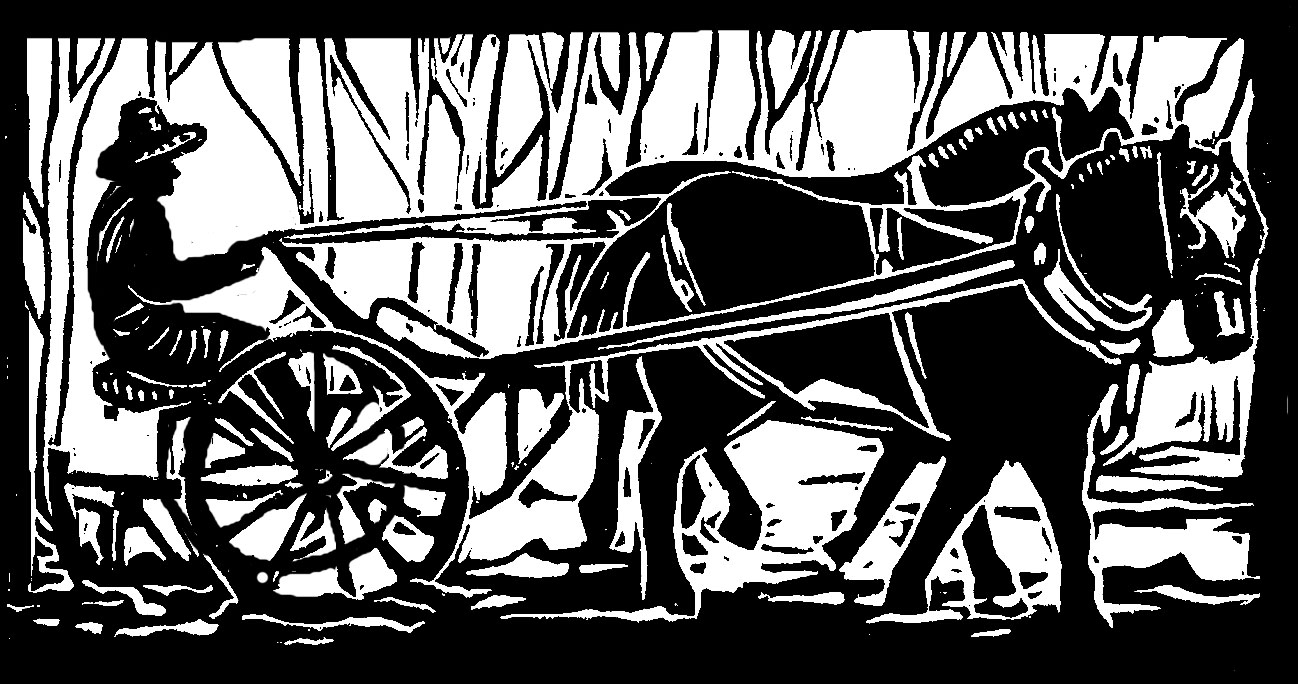
Two teams of horses: we didn’t mean to have these either. One team would seem like plenty for a little vegetable farm like ours. But if one horse goes lame in the middle of the season, it’s great to have a third horse. Plus if our three nice old horses are getting overtired in the middle of a hot haying day in July, our fourth nice old horse means we can give everybody a break. Every horse at least. Which leads to:

Two farmers: in case one breaks down, or in case you can cobble two together to make one working item . . .

Originally published in the Monadnock Shopper News, June 28 - July 4, 2023 

Nice Antique Thingy

Last spring my fellow farmer finally got to attend the draft horse equipment auction that happens every year at the same time as our farmers’ market. I reluctantly agreed to go to the market, and was relieved when our dear daughter came with me, and did most of the work.

I got a little nervous this year as the auction approached, since our daughter wasn’t going to be around to do most of the work at the market. Luckily, I was saved by the fact that we didn’t have any produce ready yet, which is not the most profitable way to run a vegetable farm, but it made for a nice farmer date, because my fellow and I went to the auction together.

First we walked around looking at all the piles of horse-related stuff, and I made a list of potential purchases. Looking and list-making were good jobs for me, since I wouldn’t even pretend to hold the bidding number card. Once the bidding starts, auctions are even more overstimulating than farmers’ markets, in my opinion.

The first round of selling was indoors: two wagon-loads of miscellaneous stuff. We bought a horse brush, which came along with a pink plastic grain scoop, which we didn’t necessarily want, but which has already come in handy to scoop soil mix out of bags. We bought four chain connectors, all linked together, that my fellow plans to use on the stone-boat. 

We also got a good start on identifying the various parties at the auction. Most of the indoor bidding was by people who must have riding stables, and want millions of halters, lead ropes, grooming kits, and muck boots. Every single item was brought up by a kid, a 4-her, we surmised, to show the crowd. Then the auctioneer would do his fast talking. It was slow going, item by item by item, through those big wagon-loads.

We had a nice break when it was time to move outside into the sunshine and breeze for the implements and parts sales. Here we bought a metal seat, a pole, several eveners and neck yokes, all for our draft horse equipment. We bought a fine pair of wheelbarrow handles.

This is also where we identified some other groups: the eight or so young Amish men, joking and jostling quietly and goofily among themselves, accompanied by two older, presumably auction-wiser Amish men.

Then there were the grubby bearded hippie farmers, such as my very own farmer fellow, buying the kind of tired stuff dragged out of a hopeful seller’s hedgerow and sent to the auction. Prices were dismally low, disheartening even if you were buying instead of selling. How come no hopeful farmer wanted all this tired but still useful horse-drawn equipment? Even the auctioneer seemed discouraged.

Occasionally and unexpectedly there would be a little run of bidding: some old ice tongs, perhaps, or a barrel. These went to the mostly-retired antiquers, looking for interesting things to put on their lawns, or to sell in their shops, or more likely to sell on Ebay. 

One of the nicest moments was watching a woman bidding against another person on some antique thingy, going up little by little until she shook her head, no more. The auctioneer called out, “New bidder,” pointing to a man standing ten feet behind the woman. The price kept going up. When the woman turned around to see who finally had the high bid, she started laughing. Turns out they were a couple, and he was laughing, too, because he had bought it for her, knowing she wouldn’t go up that high. They were well-pleased with one another.

My fellow and I were well pleased with one another, too, and our date. “You want me to buy you a nice antique thingy?” my fellow offered.

“Naw,” I answered, “You’re my nice antique thingy,” and we held hands right there at the auction.

Originally published in the Monadnock Shopper News, May 31-June 6, 2023

So Brilliant and So Not Brilliant Farmers: The Kind of Sweetheart You Want to Keep Farming With

Recently I wrote a farming column about how pleased I was at our new way of putting machinery in the barn after the vegetable season was over. The column was even subtitled: “New Good Things Can Happen.” 

Well. When it came time to take the machinery out again in the spring, we two farmers anticipated a pleasant fifteen minutes of effort. It did not take us long to realize this would not be the case, since all the implements were so tightly, cleverly jammed in that they had absolutely no interest in coming out.

“Oh, we are so brilliant, yet so not brilliant,” sighed I.

We struggled for two hours, with heavy metal bars, straining muscles, a lot of grunting, and the occasional groan. After two hours, the grunts and groans devolved into complaints and curses – and we still didn’t have the machinery out.

Now I am not saying that New Good Things Can’t Happen. Oh, no.

What I am saying is, if you and your sweetheart have worked together for many years, as my sweetheart and I have done, and the conversation has gotten rather snappish, and the project that was supposed to be easy is instead very hard, and the day is speeding by with nothing being accomplished, it’s good to consider your options (remembering, if you can, how lucky you are to have any options at all). 

a) It’s time to quit working with your sweetheart. We didn’t really want to do that, in a permanent kind of way, at least, even though we were very crabby with each other and the machinery, and every other farm project that was supposed to be easy and turned out to be hard had suddenly and just a tiny bit bitterly come to mind.

b) It’s time to quit working with draft horses and horse-drawn machinery. We didn’t really want to do that either, because we like our four horses, all of which were lazing around the barnyard and wondering why the farmers were making so much unpleasant noise in the barn. Sometimes a horse would amble over from the hay manger, peer more closely into the barn, and then amble happily away again, leaving us to our foolishness. (Plus, of course, non-horse drawn machinery also often calls for metal bars, grunts, groans, complaints, and curses, and you don’t even get to snuggle up to your tractor afterward, like you get to snuggle up to your horse.) 

c) It’s time to go look at the water hose valve. Now this valve worked beautifully for many years, giving the farmer that doesn’t like to get wet great confidence, and then the valve slowly deteriorated, and the farmer would forget, over and over again, and what would happen? Yes, she would get wet. One day, she forgot too many times, and she had also mentioned a new valve too many times to the other farmer who would be running errands, and he would have his turn at forgetfulness. 

On that fateful day, the angry, wet farmer said, “That’s it. I’ve had it. I’m not farming anymore,” as she stomped away. The other farmer went to the store, fast, and came back with the most expensive valve he could find. It worked great. 

“Look,” he said gleefully, “I’ve saved the farm and the marriage! With only twelve dollars and forty-nine cents!” Now this is the kind of sweetheart you want to keep farming with, even when you get wet, or when you pinch your finger between the heavy metal bar and the heavy metal implement, and he hurries over sympathetically, even though you are both very grumpy.

d) It’s time to eat lunch. This is often the best option, and it worked very well in this case. We ate our lunch, and when we came back to the barn, we were stronger, smarter, and friendlier. We got the machinery out.

Originally published in the Monadnock Shopper News, May 3 -May 9, 2023