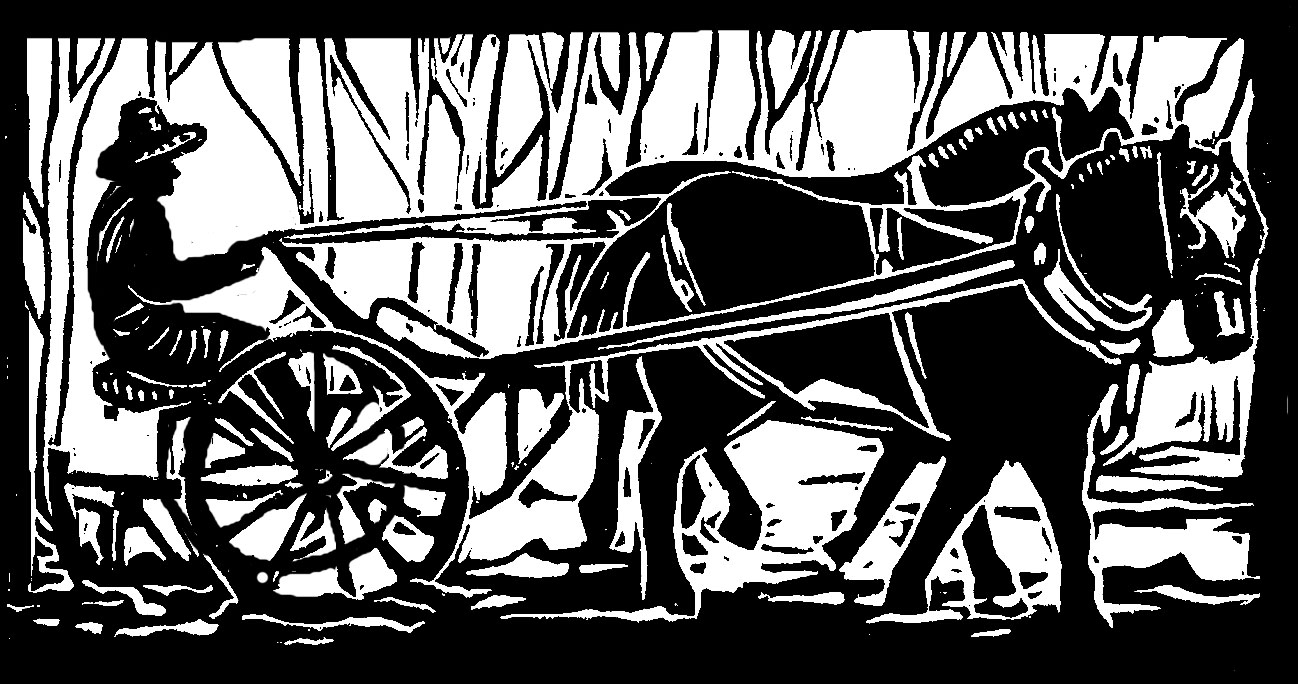
Borrow-a-Draft-Horse Agency: Thank Goodness for Farriers, Mothers, and Draft Horses

We farmers were stumped. With three out of four draft horses unable to work, due to injury, and our first decent stretch of haying weather coming up, late in the summer, we needed to borrow a draft horse, in a hurry. But how likely was that?

“Maybe we could call the Borrow-a-Draft-Horse Agency?” I suggested.

“Let’s think,” answered my fellow farmer, “Who could we even ask? X’s team is pretty old, and he won’t want to split them up, anyway. Y’s horse might like the company of our horses, but Y would miss her horse too much. Let’s try Z.”

“And A, and B, and C,” I added, so we made phone calls and sent emails, thinking our chances were pretty slim. How many people have draft horses anyway, and who in their right mind would ever loan one?

Luckily, our farrier, Jake, whose generosity far outweighs his right-mindedness, said “Sure, you can borrow Button. She could use the work.”

We could hardly believe it, and we not only borrowed the horse, but the horse trailer to haul her. Button, who is half-Belgian and half-American Cream, is a big horse, a beautiful pale gold color. She was also out of shape, a “cream puff,” said our farrier’s mother, Mary. In fact, Button was so round and gold we were tempted to call her Butterball instead of Button.

Button was not pleased to be separated from her two pasture-mates. Happily, Mary helped us, leading Button into the trailer, multiple times. Button backed, right off the trailer, multiple times. Mary sighed, led Button’s mother into the trailer, tied her, led Button in, tied her, then untied and backed Button’s mother off again.  

Thank goodness for mothers, we were thinking. 

But “Thanks, George!” was what Mary said, relieved. George is Mary’s spouse, and Jake’s father. George died, in 2021, of cancer. George was also a farrier, and a teamster, and a draft-horse legend, and he carried that great spirit of generosity we still see in Jake. We all miss George. As my fellow farmer said, “I never thought I’d get to drive a horse that George trained.”

Button gradually settled down on our farm, showing her solid training, and remembering her good manners. But that didn’t mean she wasn’t a handful. George liked “hot” horses, and Button is hot. (She’s a hot button!)

At our farm, we introduced Button to just one horse, Clyde, while our three recovering horses stayed at our neighbors’. Luckily Clyde is a very steady, sleepy horse, so he made a good calming partner for the high-headed Button. 

Button was learning a lot, and so were we, such as how Button likes to run away when she sees a person coming with a halter. A person without a halter? Button is your best friend. Still, a horse-horse relationship always tops a horse-human relationship, and Clyde never minds being haltered. So we would halter Clyde, as Button trotted around in circles, and then walk away. By the time we got to the gate, Button would give up, and stand for the halter.

Button loved Clyde, but she didn’t love all the rest of the new stuff: new stable, new harness, new noisy scary farming activities. But she managed. She even muscled up. 

“I think we’ve gotten her from cream puff to cream cheese,” my fellow reported to our farrier and his mother. “She’s doing great.” 

Button is doing great, and are we ever glad to have her visiting, hot or not. She is getting us through one long hard garden season, thanks in no small part to George, and to his human and horse legacy. 
 

Originally published in the Monadnock Shopper News, Oct 18 - 24, 2023

If Wishes Were Horses . . .

We’d have plenty to drive.

Wish it Didn’t Happen, #1: In a classic example of farmer exhaustion bordering on farmer foolishness falling into farmer-causing-harm, we accidentally dropped our barbed wire gate too close to the pathway. When my fellow farmer brought all four horses to the pasture at once, which he often does, one horse got caught in the wire. This was very bad, and this is exactly the reason you should not use barbed wire with horses.

I heard the ruckus and went running. Clyde and Moon, still tied together by the halters, were galloping in a panic. My fellow farmer, also panicked, was trying to untie Ben from Molly, who was caught in the wire. I unhaltered Clyde and Moon, and my fellow got Ben free, and the three settled down to graze nearby. Then I held Molly’s halter, and my fellow worked the wire cutters. We were very lucky, as Molly only had surface scratches on one leg.

Wish it Didn’t Happen, #2: Ben, our big black Percheron, made some strange loud breathing noises twice last year as he was working. Maybe it was because both days were hot, the hay loads were heavy, and Ben was working with Clyde, not his favorite partner in harness. But it didn’t happen again, and this spring Benny did some heavy work without incident. 

Then came the incident: a hot haying day, with Ben and Clyde. Ben started making the big noise when they were in the barnyard, pulling the wagon. 

“I don’t know what to do,” said my fellow, as we hitched the hay wagon to the hayloader.

“I don’t either,” I said. “Let’s just see how Ben’s doing at the top of the hill.” 

Well, Benny didn’t make it to the top of the hill. He hardly made it to the start of the hill. He made the noise, and then he staggered, and then he collapsed in a ditch. He tried to get up. He couldn’t get up. It was dreadful.

We managed to unhook Ben from the wagon and from Clyde (who stood like a dream, when he could have easily panicked). We thought Ben was going to die right there, in the ditch. But all of a sudden he heaved himself to his feet. He stood there a moment. Then he put his head down to grab a bite of grass. We were dumbfounded.

We took Ben slowly back to the barn – by then his nose was bleeding – but he drank water and ate hay, and the bleeding stopped. We headed back to the hayfield with Clyde and Molly. After haying, Ben still seemed fine, so we led all four horses to pasture, figuring if Benny was going to die in the night, he’d rather do it in the green grass with his herd near him. But the next morning, there he was, big as life, grazing along, and wondering why we were making such a fuss over him. 

We did a little research, later confirmed by the vet. Turns out Benny is a roarer. His larynx is paralyzed on one side; he couldn’t get enough air during heavy exercise and passed out. This happens mostly in racehorses, and a nosebleed often follows. (Surgery is possible, but not always successful.) Benny is twenty years old, and doesn’t have any roaring problems at leisure: thus he is officially retired. 

Wish it Didn’t Happen, #3: Molly’s other leg is swollen. She is lame. We call the vet. Apparently we missed something from the barbed wire episode. With antibiotics, she comes through fine. But she can’t work. So we prevail on Moon, her brother, who has been fully retired for three years, to do a little raking and tedding of the hay. Though he is willing, he gets a sore shoulder.  

We now have three out of four work horses that can’t work.

We also have a lot of hay to get in, and a lot of garden tasks. As crazy as it sounds, we are able to borrow a draft horse. If wishes were horses . . .


Originally published in the Monadnock Shopper News, Sept 20 - 26, 2023

Large, Lush Weeds

Recently I was standing at the garden gate with one of our CSA members. Mostly we saw large, lush weeds.

“How do you even decide what to do next?” the person asked.

I laughed. “This is the time of year when I have to block out 98% of the farm in order to get anything done.” This is especially true on harvest day, and especially true in a year that has been so soggy that sowing, transplanting, and weeding are sketchy at best.

Earlier that very harvest day, I picked the salad turnips out of our little greenhouse, trying not to worry about the lettuce in the next beds. Given that we just lost two plantings of outside lettuce to the rain, we thought we’d better put this lettuce under cover. That meant the lettuce lingered in the flats far too long, as we gradually harvested the previous greenhouse crop.

The lettuce has taken pretty well, and it needs weeding already. But I can’t think about that right now. I hurry back to the shed with my turnips, to hear the Swiss chard harvest report from my sighing fellow: “I had to toss half the leaves. They were all shot from the rain.” 

For his part, my fellow had to block out the leeks, right next to the chard. It was probably pretty easy to block them out, as they are so weedy you might not even know they were there. My fellow went on to pick the broccoli, ignoring the nearly invisible-for-the-weeds carrots in the next bed. 

Meanwhile, I had the happy task of harvesting the scallions, which were undaunted by all the rain. The cabbage seemed to be all right too. If only we had planted nothing but cabbage and scallions this year! Wouldn’t our CSA members have been surprised - there must be lots of interesting ways to fix cabbage and scallions for supper.

My fellow farmer and I had to gird our loins to pick the next crop – yellow squash, zucchini, and cucumbers, if you could call them a crop. Normally this time of year we are harvesting six five-gallon buckets of cucurbits. But with the unhappy circumstance of squash bugs overwintering in the greenhouse, carrying the virus that kills the plants, followed by an aphid infestation the likes of which we’ve never seen, and hardly any sunshine, we came away with a half-bucket total of cukes, 4 yellow squash, and zero zucchini.

But we had to keep going. It was harvest day, after all. The shiitake mushrooms have done pretty well, though the rain-loving slugs are enjoying more mushrooms than we’d like. The tomatoes taste particularly good this year, perhaps because vegetables grown under tougher circumstances tend to taste sweeter, but there aren’t nearly as many as usual. Same with the eggplant and sweet peppers and basil, all greenhouse crops: they’ve been getting less rain directly on their heads, but the lack of sunshine hasn’t helped them at all. 

But hey, the kale looks great, inside and outside the greenhouse! Our CSA members could add kale to their lovely cabbage and scallion salads. The cutting flowers look good too: maybe next year we should grow all edible flowers, instead of decorative ones. (Of course, next year there could be drought instead of flood.)

Back in the shed, harvest done for one more day: 98% of the garden sort of successfully blocked out, so we can get out our 2% accomplished. 

“Look at this abundance!” says our nice CSA member, gesturing to all the freshly harvested and washed vegetables.

We do look, and are pleasantly surprised. We’ve got some veggies for the people. Maybe not as much as usual, but still there is quite a lot, despite the rain and the weeds and the worry. We may be sodden here, but we haven’t lost everything to floods, as some farmers have. Plus the large lush weeds sure help keep the soil in place.

Originally published in the Monadnock Shopper News, Aug 23 - Aug 29, 2023

Growing Potatoes Instead of Potato Bugs

Last year our potato patch produced a whole lot of Colorado potato beetles, and not many potatoes. This year we are trying to grow potatoes instead of potato bugs.

At first, on the newly sprouted potatoes, we found adult beetles, heavy-bodied, black and yellow striped, kind of nice-looking bugs, who don’t bite or sting. They overwintered in the soil, and then travelled gleefully to the new potato plants. 

Despite picking off as many bugs as we could find, pretty soon there were the beautiful golden-orange eggs, adhered to the underside of the leaves. We took off the eggs, too, but we clearly missed quite a few in our six 200-foot long beds of potatoes. Next came the red larva, in all sizes, growing rapidly from pencil point to fingernail. 

Now we’re onto a new wave of adults, and I sighed to my fellow farmer, “How long do we have to keep those potato plants alive?” 

“Three months,” he answered, sighing too. 

Defoliation by the beetles seems to happen in the blink of an eye, but we know that is not true. We just have to keep picking those bugs regularly. At first I squished them between my fingers, but when we got to the larval stage, I was feeling iffier about the whole squishing project. 

My fellow was brushing the beetles into a yogurt tub instead, which is a lot easier. Then we put a little water in the tub. I don’t suppose it makes much difference to the beetles, but it is more pleasant for the bug-picker.

There are days I envision myself as a clever bird, picking bugs with my beak-hand. There are days when I envision myself as a clever lady bug or squash bug, both of which eat potato bug eggs. (If only the squash bugs would stay in the potatoes and leave the squash alone!) There are days when I envision myself as a clever farmer, saving my potato crop without using pesticides.

Then there are other days, such as the one when I had gone up and down the potato beds three times already that morning. Every time there were more and more bugs. 

“I’m going to patrol those potatoes all day,” I said to my daughter, who laughed, and said “What’s that short story about the crazy woman walking around and around her room all day? You’re the crazy potato lady.”

I felt a little crazy, picking my bugs, when so much else was pressing in the garden: from transplanting to weeding to harvesting. Yet I had already spent so much time on the potatoes, I hated to give up. So I kept picking, and I did some research.

A female can lay up to 500 eggs in batches of 10-30, which can take 3 or more days to hatch, depending on how hot it is. A potato plant can withstand 30% defoliation at leaf-growing stage, but only 10% defoliation at tuber-growing stage. The stage four larva, the biggest ones, do the most damage.

But the most interesting thing I learned was that potatoes are native to the Andes, and the Colorado potato beetle is not a crop pest there, because of the different climate. The beetle was identified in Nevada and Colorado, on potatoes, which the bug much prefers to its native host weed. Ah-hah! I thought, it is we humans who have upset the balance, by bringing the potatoes to the bugs.

In any case, I am in my potato patch, every three days, picking bugs, feeling a little crazy, reminded of the contemporary Syrian/Lebanese poet Hoda al-Namani’s haunting verse: “I have not withdrawn into despair, / I did not go mad in gathering honey, / I did not go mad, / I did not go mad, / I did not go mad.” 

No indeed. I did not go mad in gathering bugs. I am gathering honey, I am gathering mashed potatoes, fried potatoes, baked potatoes.

Originally published in the Monadnock Shopper News, July 26 - Aug 1, 2023