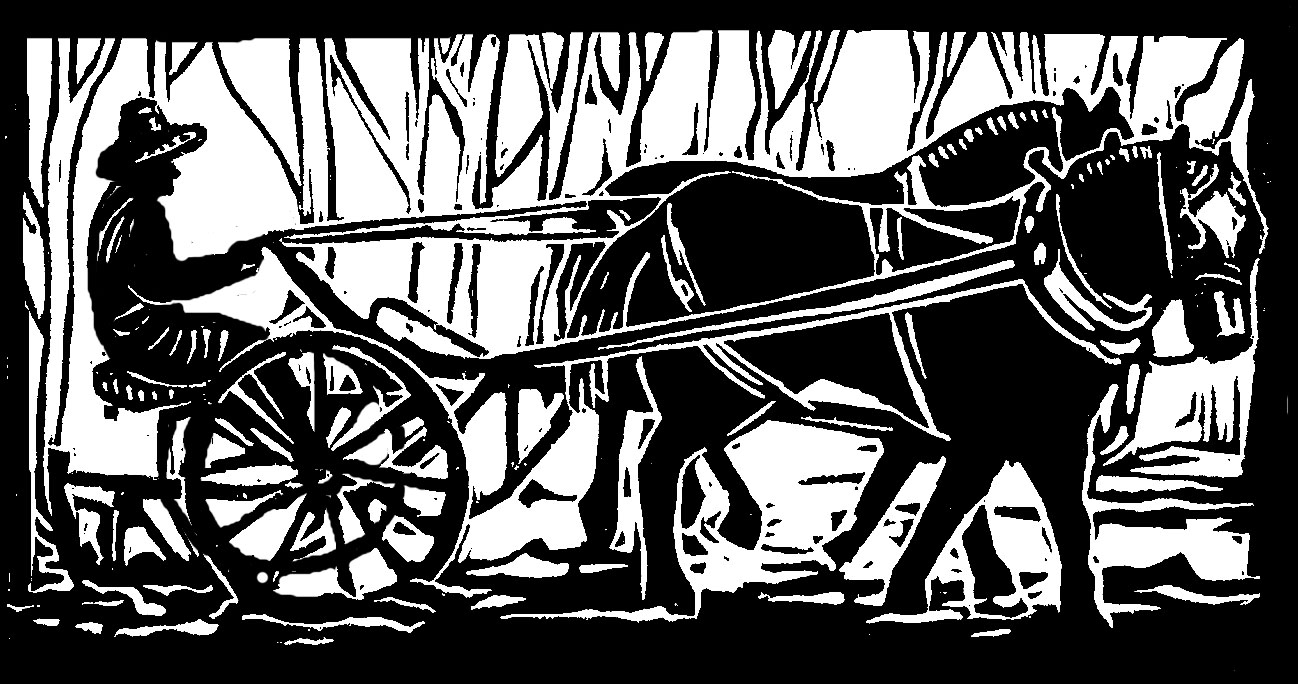
Farmers and Horses: All Stirred Up

We farmers have been trying to remain calm. But we’re all stirred up, and not just because of the springy feeling in the air. It’s not just because we’re working in our greenhouses: raking beds, setting up propagation tables and heat mats, hauling in potting soil and seed packets.

No, we’re stirred up about horses. For one thing, we’ve been feeding grain all winter to our four draft horses, because they’re all at the age when a little extra in the winter helps. 

Now grain is highly exciting. It’s hard for a horse to keep calm in the face of a grain feeding, and it does a farmer good to remember the order of things: which horse to halter and bring in to the stalls first. Which horse will stand nicely next to which horse, even when grain is on the way. Which horse gets a little more grain, because they’re harder keepers, and which horse gets a little less, because they’re easy keepers.

Most important is which horse goes out of the stalls first. For instance, yesterday I brought Ben out first. He went nicely over to the hay waiting outside. Then I brought Molly out, not realizing she was going to race back in and check Ben’s grain bucket to make sure he hadn’t left any crumbs, either in the bucket or on the ground. 

Meanwhile Moon, who I hadn’t even bothered to halter, because he went into his stall on his own, decided to come out. But I was already asking Clyde to back out of his stall, and then I had to both keep Clyde in one place and try to get Moon out of the way at the same time. Finally Moon cooperated, but I had forgotten about Molly and Clyde.

Molly was sure Clyde was going to get the grain crumbs, so she started bucking and squealing, and Clyde stopped backing, and I said “Molly, for heaven’s sake!” and chased her out of the barn, while Clyde waited for me. Then I went back for Clyde, led him out, and was getting ready to take off his halter at the barn door, when Molly decided to squeeze past back into the barn.

“Molly, you turkey!” I said, letting go of Clyde, who went forward, and didn’t want to stop for me to take off his halter because now Molly was behind him. But he finally did, and pretty soon I had four horses calmly eating hay in the barnyard. 

All this is to say that grain is as exciting to horses as horses are exciting to horse farmers, which is why we farmers are all stirred up: we’re planning to buy a new team. We don’t really want to buy a new team, but our nice old horses don’t have the pep for another full garden season. 

We get pretty jazzed up on our horse trips, sure that this will be the perfect team for our little farm. So far we’ve been to Connecticut to look at a giant team of Belgians, about whom my fellow farmer said, “It makes my stomach hurt just to think of those dinner-plate hooves trying to walk down our narrow garden pathways. All those heads of lettuce going crunch crunch crunch.”

We’ve also seen a pair of black Percherons, who had the opposite effect: “It makes my stomach hurt to think of asking these two little horses to pull a full hay wagon up and down our hilly fields.” Way out in western New York State, we saw two more giant teams of Belgians, and a lovely little too-expensive pair of Belgian mares. 

Next we’re headed to Maine to see three more teams. Maybe one of these will be the perfect team for us! Meanwhile we visit our four perfect grain-loving horses in the barnyard, wishing they were a little younger, and reminding ourselves of just what kind of horses we’d like to have come live and work with us.


Originally published in the Monadnock Shopper News, March 6-March 12, 2024

A Pleasant, Peculiar People

Recently we farmers hosted a birding event. We prepared by reading our bird notebook, with its twenty years of birds we’ve identified here on the farm. Plus there are records of early frosts, and July hail, and lots of animal sightings.

“Remember the loon flying overhead?” we said. “Remember the bobcat? Remember the first time we saw the pileated woodpecker? Remember the bear, and the moose? Remember the yellow-rumped myrtle warbler by the pond?” 

We are amateur birders at best, but we had a pretty good list to read to our visitors, in case there weren’t any real birds out and about at the end of January. Plus we had our mammal and amphibian lists: even more diversion for birders not seeing birds.

The event, sponsored by the Cheshire and Windham County Conservation Districts, attracted a good group. We had the farmers, the conservationists, and experienced and brand-new birders, coming from Vermont and New Hampshire.

Now birders are a pleasant, interested, interesting people. Individually, they are eager to tell you their birding stories and to listen to your farm stories. Collectively, they are a bit more peculiar. 

But we had been warned: in the middle of the most fascinating remarks on small sustainable farming and its wonderful effects on bird populations and diversity, suddenly one birder would point at the sky, and the whole group would swing up their binoculars and turn as one to gaze at a tiny flying speck. Then there would be a long pregnant pause, followed by a spirited discussion of the speck. Then the crowd would turn smiling back to the farmer or conservationist that had been mid-speech.

There was only one point during the tour that there were no arms pointing or binoculars lifted. That was when we visited four really big birds in the barnyard: four draft horses, two of which ambled over for petting, and two of which kept eating their morning hay.

After we talked about our nice horses and our nice heavy use protection area grant in the barnyard, we went on to the garden. Suddenly the birders were all a-twitter! There were red crossbills, calling and flying! The farmers were all a-twitter too: we had never seen or knowingly heard a crossbill on our farm!

There was an evening grosbeak on top of a pine tree, a beautiful golden bird that sometimes visits our bird feeder, and who was a first for some of the birders. There were two red-tailed hawks. There were purple finches, New Hampshire’s state bird. By then some of the birders were in bird-list bliss.

At each stopping point we farmers told a bird story: the red-tailed hawk that had gotten caught in our former mesh garden fence, and how glad we were to set it free, and how glad we were for another conservation grant that allowed us to put up a metal fence that didn’t catch birds. All the birders nodded happily. 

We talked about how birds benefit from the farm’s crop diversity, mulch, cover-crops, and low-till agriculture. We mentioned the tree swallows’ lovely liquid call as they swoop around our garden catching bugs. We pointed to all the wild, bird-friendly edges of the garden. 

We went on to the pond, the mushroom yard, and the fields, where the birders showed their mammal mettle by identifying possum, rabbit, and deer tracks. We talked about pasture conservation projects, and one birder said maybe we could see flocks of nightjars migrating if we stood on the edge of our biggest field at dusk in September. 

We liked that idea, especially since the only nightjar we’ve heard on our farm was identified by a visitor. We’re not even sure that hearing a bird counts for your bird list, but as I say, we are amateur birders, so we’ll take everything we can get. That day we got 18 different species, and we got a nice bunch of birders on a warmish day in January, loving birds and loving farms.
 

Originally published in the Monadnock Shopper News, Feb 7 - Feb 13, 2024

Pretending Farming Doesn't Exist

It was such a wretched season on our New Hampshire vegetable farm, what with the cold wet spring, and the limping collapsing draft horses, and the cold wet limping collapsing farmers, that we were glad to say goodbye to the whole year. 

Once our CSA vegetable distribution was finished up, and our horses were settled into the winter paddock, and the limpers and collapsers had recovered, all we had left was cold and wet, which we've solved by sitting by our woodstove. 

We sit by the stove, and ask ourselves probing questions, such as "Now why are we doing this again?"

Then we refuse to give ourselves a pep talk about fresh food and sustainable farming and local economies and healthy environments. Instead we pretend that farming doesn't exist. What fun!

It is so much fun that we take ourselves to a nice concert in South Hadley, Massachusetts. The concert is in a pretty little Episcopalian church, clean and bright and dry and tidy, which reminds us not at all of farming. 

We listen to the wonderful Scandinavian folk'appella group Kongero. Four women with stunning voices sing in Swedish for two hours, and it doesn't matter that we can't understand a word of the lyrics, because certainly they are not about farming. 

The singers do take pity on the mainly English-speaking audience, and tell us a little in English about their group. They say that kongero means spider, in a Swedishish-Norwegian dialect, and that a music reviewer suggested that they were one voice with eight legs. 

Although we still don't know exactly why the group choose kongero for a name, we can only assume that the Swedish have great love for spiders. We are also a little concerned that spiders, especially the big beautiful slightly scary garden spiders, are veering awfully close to, you know, farming. 

Then one of the singers introduces the next selection, a very old song. A very old . . . cow-herding song. Uh-oh. She even translates the verses. 

Then she tells us how she spent her summer working at a living history museum. It was a historical farm of the late 1800s museum. Oh, geesh. Not only that, she was the goat-herder. Not only that, it was a beautiful song. 

Well, we gave up pretending that farming didn't exist. Instead we had a nice little chat at intermission with the goat-herding singer, about our nice little CSA farm with our nice not very little draft horses and our nice many-sized vegetables, and she told us that she grew up in a 24-person northern Swedish village, on a small farm with chickens and sheep and pigs and cows and horses. 

She said that in Sweden, too, agriculture has been taken over by big corporations, but that little farms were coming back. Oh, nice little farms, keep on trying! was the general gist of our conversation. 

So there we two New Hampshire farmers were, right back to farming, and we were even feeling kind of happy about it. If only we could sing as beautifully as a spider when we were herding our (virtual) cows and our (virtual) goats and our (very real) horses and our (very real) vegetables, we'd be doing pretty well. 


Originally published in the Monadnock Shopper News, Jan 10 - Jan 16, 2024

Horse Sense

Our four work horses have had a tumultuous season. When three out of four couldn’t work, from age or injury, we borrowed a horse from our farrier. Introducing a new horse to a herd is always a tricky business.

We started with the new mare, Button, and our horse, Clyde, as they would be the working team for a while. They got along nicely. Meanwhile Molly, Moon, and Ben were in our neighbors’ pasture, where they always spend part of the grazing season. When Molly recovered from her lameness, we brought the three back home. 

It was a beautiful sight: five big draft horses, one black, one red, two gold, and one cream, all galloping around on the green green grass. Great! we said, until the next morning, when Moon got out, all by himself, and went back to the neighbors.’ 

We fetched Moon home, thinking he had just gotten tangled up somehow. But it turned out that Moon was sore afraid of Clyde, because Clyde had decided that with two mares around, it was time to be a serious boss hoss, and he chased Moon and Ben away aggressively.

Ben is all right with some distance, but Moon grew up with Molly, and he wants to be next to her at all times. Clyde would no longer tolerate this. Thus we had a new configuration: the main herd (of three), and a new bachelor herd (of two), just like in the wild. Okay, we thought, that’s fine.

The next escape was an hour later: Moon and Ben got out and went to the neighbors.’ We gave up, and left them there, thinking these horses had a lot more time to get out than we had to get them back in. Occasionally there was some neighing back and forth, but for the most part all was calm.

After nearly two months, when we finally had our hay and garden work done, we took Button home. We brought Moon and Ben back into the fold, thinking there would be no problem. Ha! 

Clyde still chased Moon and Ben away, a long way away. The two pairs of horses had lots of room in our big pasture, but we were beginning to wonder what we would do when it was time to bring them all into the smaller winter paddock.

By November, trying to hold off on the paddock, we were setting out hay in the pasture. But when the snow came, Molly and Clyde walked past the hay, and went on a jaunt to the neighbors.’  

“For crying out loud,” we groaned. All right, now Molly and Clyde could stay at the neighbors.’ But in fifteen minutes, they had gotten out of the neighbors’ pasture and come home again. This was also the day before Thanksgiving, and we had planned to visit family. These horses were not helping. We ended up taking all four of them back to the neighbors’ pasture, along with two mangers of hay.

Happily, everything went fine while we were away. When we got home, we wanted to bring our horses home too, where all the hay and water was. So we split our winter paddock, with a classy arrangement of metal gates and a wooden pallet, because the gates weren’t quite long enough. 

We fed the two horse pairs at opposite ends of the paddock. Gradually, we planned, over some weeks, we would bring them closer and closer together, and maybe they would all remember how to get along. 

But the funny thing was, all four horses already remembered. On day two, they were calmly eating near each other, next to the gate divider. By day four, we opened up the gates. By day six, we took the gates down entirely.

“What’s the big deal?” the horses seemed to say. “This is how we always spend the winter.” 

Huh. Well. We humans might have saved ourselves some trouble, if we had a little more horse sense.


Originally published in the Monadnock Shopper News, Dec 13 - Dec 19, 2023