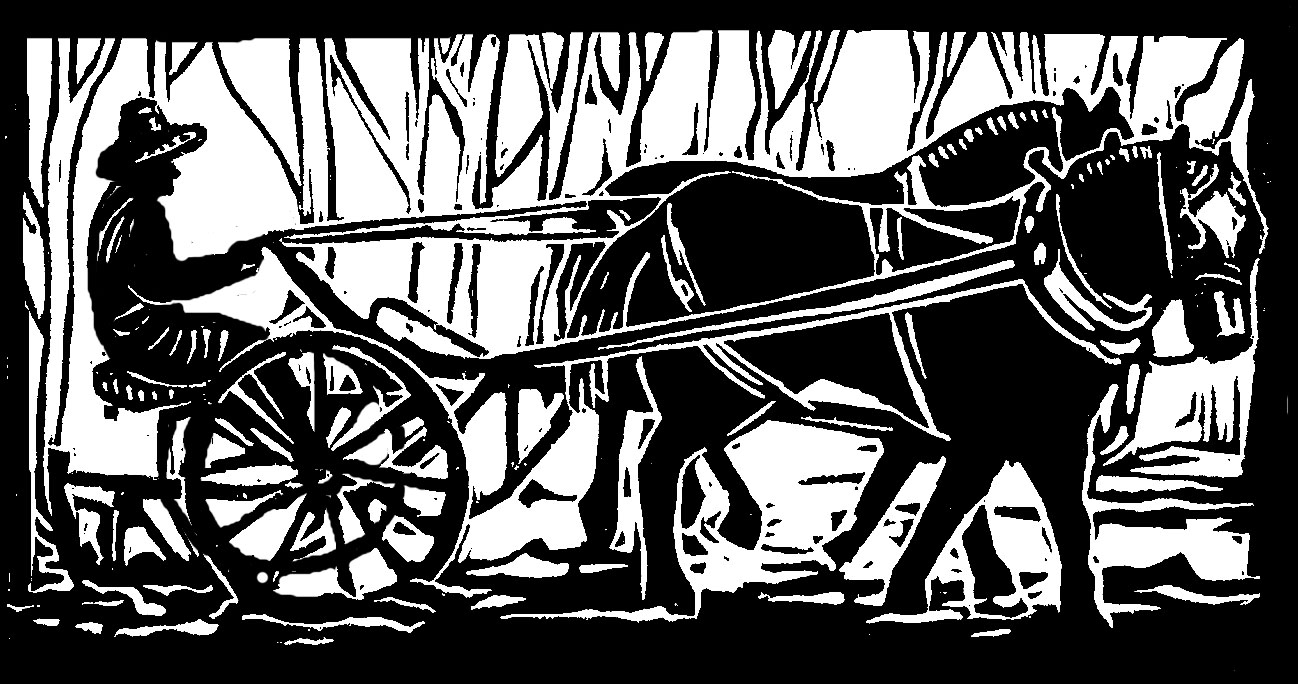
The Big Hayloader Moment

Our new team of horses was going to be haying with us for the first time, and I was nervous.

On mowing day, Willow and Fern were not daunted by the strange clackety-clack of the sickle bar mower. The next day, they weren't bothered by the whir-whir of the tedder. The third day, there was no problem with the quiet rake.

But the next step was the big one: introducing the hayloader. If draft horses are going to be afraid of farm machinery, it's often the hayloader that worries them. It's a big noise coming from behind, high up, and some horses do not like that at all, which is why I was nervous.

After the raking, the horses rested in the barn with hay and water, while the farmers got the barn ready.

Ideally, this would have been done well ahead of time, but every year, it gets done the hour before the first load of hay comes in. Or, rather, the hours. We had to move out the two hayloaders, the spreader, the tools, the piles of junk accumulated over the winter. We had to move a million greenhouse tables that had been set outside in the way.

I got more and more nervous as the hours ticked by. I wanted to get the first haying over with, so I could quit imagining disasters.

Luckily our daughter was home, with a visiting friend, who wanted to help hay. The vigor of two twenty-five-year-olds got us through the hours of junk and table moving. Plus I couldn't let my nervousness turn to outright grumpiness when we had a guest. So when my fellow remembered he had to put a new pole on the hay wagon, and we needed to cart a lot of musty old hay from the barn to the compost pile, I had to grin and bear it. Or just bear it.

Finally we were ready for the big moment. I worked hard to imagine everything going smoothly instead of runaways and smash-ups and horses getting hurt and farmers getting hurt and daughters getting hurt and guests getting hurt.

First we hitched the horses to the wagon and hayloader in the driveway, and my thankfully calm, confident fellow asked the team to walk just a few steps, with the hayloader out of gear, to minimize the noise. Willow and Fern flicked their ears back, listening, but weren't alarmed.

Then came the pull up the hill, including the top of the hayloader catching on branches, and the rattle and bang over rocks in the lane. I walked briskly ahead, with a pounding heart, in case I had to try and stop stampeding horses. At least it is a steep hill, so the horses would have to work hard to run away pulling the haywagon and hayloader.

But Willow and Fern weren't even considering running away.

In the field was the last test: putting the hayloader into gear, which made more strange new noises. Willow and Fern didn't blink an eye. Then the full glory of this new team of horses was revealed. Tried and true, slow and steady, their classic funeral pace proved to be a blissful match for hayloader work.

My fellow farmer, our daughter, and this nervous farmer were all exulting. How easy! How fun! How downright relaxing to make hay with these fine and slow horses!

Our guest seemed surprised by the nervousness/borderline grumpiness turned to glee. “I guess I came on a good day to hay,” she said.

“You sure did,” we burbled. “No smash-ups, no break-downs, no runaways, not even a person falling down over and over trying to load the hay while the wagon jerks and jolts and bounces behind a trotting horse!”

“Wow,” said our sweaty, chaff-covered, worn-out guest, who was probably glad we hadn't mentioned such possibilities earlier.

“Yes!” we said. “This is heavenly haymaking! Lo, the hay angels are singing!” (Well, we didn't really say that last bit, because we didn't want our guest to think we were entirely wacky.)


Originally published in the Monadnock Shopper News, Aug 20 - Aug 26, 2025

Laughing or Crying: July on a Vegetable Farm

You know it's July on a New Hampshire vegetable farm when the best fantasy a farmer can muster up is washing the dishes.

Why, washing the dishes could take two or three hours, since there's no clean silverware, plates, bowls, glasses, pots or pans. Two or three hours, in the nice shady cool house, standing up, as opposed to kneeling and weeding the endless rows of vegetables in the blazingly hot garden.

Washing dishes sounds like fun! It might even lead to a meal, since there will be both clean pots to cook in, and clean surfaces to chop on, and clean dishes to eat from.

Washing dishes wouldn't take much muscle, and not much brain power either, since a farmer's muscles and brain are both sagging in July. Harvesting three times a week, both for fifty-plus CSA members and for the farmers' market, means a fair amount of organization and detail, not to mention physical labor. 

We are also sowing and transplanting the fall crops, irrigating, stringing up and pruning the tomatoes, trying to keep the cucumbers on the fence, trying to keep the woodchucks out of the greenhouses, the squash bugs away from the zucchini, the flea beetles away from the brassicas, the Colorado potato beetles out of the potatoes and the eggplant, the deer out of the garden, the horses in the fences, the farm pooch on a good walking schedule. 

We can't forget the farm kitty, who must be pet at least once every few days, when she's not busy doing her rabbit-catching job in the garden. We are making hay with our horses, too, and the hay picking-up keeps coinciding with the 90 plus degree days. All the time the weeds are growing, everywhere at once, and our nightmares are of bindweed and quack grass and hairy galinsoga. 

This is July, on a vegetable farm.

My other July fantasy is blinders. Work horses wear blinders on their bridles to help them focus on their task, and not be startled or distracted by everything they see with their nearly 360 degrees of vision. This farmer wants some blinders. I need help focusing on my task, of planting the fall broccoli, say, because the minute I step out of the house, a thousand million vegetables call for my help. Weed me! Water me! Feed me! Love me! 

Oh, oh, oh, July.

Recently our dear daughter came to visit for the weekend. Why she came in July is a mystery.

“How's it going?” she asked me, which is a kind question, considering she knows exactly what July means here on this farm.

“Well, I'm a little overwhelmed,” I answered.

“Tell me about it,” she said, which was even kinder. Who wants to hear their parents list all the work that needs to be done? Especially if visiting for the weekend might mean doing some of that work?

“Really?” I said. “Tell you everything?”

“Yes,” she said, laughing at my eagerness. 

I went through every crop in every greenhouse and garden section and told her every single thing that needed to be done. It took a long time.

“Wow,” said my daughter, “I can see why you feel overwhelmed,” and that was the kindest thing of all. A little sympathy goes a long way with this farmer, and pretty soon we were both laughing, about how much there was to do, and how we weren't doing it. 

Instead we were nudging the dirty dishes over on the table, so that we could eat some chocolate chips and peanuts. Never mind the delicious snap peas, the delicious cherry tomatoes in July. Hee hee hee, we said. Chocolate chips and peanuts!

It's laughing or crying this time of year, it seems like. Or a good farmer fantasy, such as washing the dishes.


Originally published in the Monadnock Shopper News, July 23 - July 29, 2025

The Wary Writer, the Generous Farmer, and the Bouncing Dog 

Recently my fellow farmer asked if I would tend the farmers' market stall for a few hours so he could go to a volunteer-thank-you barbecue.

“I have to be there a little early,” my fellow said, “to help get ready.”

“How early?” I asked warily. I love when my farm fellow, the farm vegetables, and the farm pooch go off to the market, leaving my Saturday morning free for writing, 

“Just a little bit,” answered my fellow. The little bit got bigger and bigger: he needed to set up tents, bring the drinks and ice, pick up some charcoal on the way . . . my generous fellow was volunteering for the very barbecue he was supposed to attend to be thanked for volunteering.

We got up especially early that morning, to pack everything for the market and for the barbecue.  The everything would not fit efficiently into one vehicle, as was the plan. The morning sped by, as the farmers got harried and grumpy. It was pouring rain, which didn't help any. 

Finally my fellow roared off in the truck with barely enough time to get the stand set up before the market opened. I had 15 minutes to mourn my lost writing hours, then I roared off too. 

At the market, my fellow and I hurried to transfer the barbecue things from the car to the truck, while keeping an eye out for customers. My fellow had everything ready for me to take over: the tent, the table, the scale, the veggies, the farm pooch . . .

Well, maybe not the farm pooch. “You won't believe this,” said my fellow, “but we forgot to pack the leash.”

I groaned. 

“I used the ratchet strap instead. It's nice and sturdy,” said my fellow.

“But you need the strap to keep the tailgate on the truck, so all your coolers of ice and drinks don't fall out!”

“Oh, yeah,” he said. “I don't know what to do. I'm going to be late!”

I rooted around in the car and found a piece of sturdyish twine for a tether. My fellow strapped up the tailgate, and rushed away.

The pooch, tethered now with the twine, jumped in the hatchback of the car to enjoy a chewy treat I brought. He could take a nap in the car, or visit with me, or greet customers. 

Of course, it was still pouring, which meant only the most stalwart of market-goers appeared, with their raincoats and umbrellas. When everybody asked where my fellow farmer was, I said, “I don't know if it's worse to be at a barbecue in the pouring rain, or at the farmers' market in the pouring rain!”

After a while, the rain eased, and more people came by, including the first dog person of the day. She happened to be the very one who had helped us with training in our wild puppy days, and also happened to have her own dog with her.

“Oh, good morning,” I said, “How nice to see you!” At the same time there was a little commotion behind me. I turned around to see my pooch bouncing over to greet the dog. 

“The string broke!” my market stall neighbors called. Luckily I was able to corral my pooch before he could begin an all-out play session in the middle of the stall.

Our dog trainer friend had also brought her family: her husband held my dog, while her son held her dog, and she bought some spinach. Then her husband kept holding my dog, while I sold some lettuce to another customer, and rooted around in the car again. This time I came up with the dog seat belt, which made a fine, if short, leash. I offered thanks all around, including to the sun, now peeking out.

In the end, I sold all the produce, my market neighbor helped me take down the tent, and me and the pooch went home for a long nap. Plus the sun came out at the barbeque too.

Originally published in the Monadnock Shopper News, June 25 - July 1, 2025

Help! or A Call to Farms!

A month ago we two farmers were dithering about what to do. We were dreadfully behind on several farm projects, as opposed to our usual worryingly behind. But were we dreadfully behind enough to send a call for help? Or could we recover and manage on our own? The gardening days were ticking by, and we were feeling more and more pitiful. 

"Should I ask our CSA members? Or not?" I said to my fellow. I didn't want to press too hard on the community in Community Supported Agriculture. "What do you think?" I was holding my sore shoulder, and he was holding his sore head.

"Yes," answered my fellow. "You could say it's a call to farms!"

"Hee, hee," I said. "That's a perfect title." Buoyed by my fellow's funny joke, I sent an email to our CSA members. The message went like this: 

"Would you like to learn how to inoculate a log to grow shiitake mushrooms? Or prep a greenhouse bed? Or hang tomato strings? Or transplant? Or a million other farm tasks all happening right now?

We have multiple sowing, transplanting, and greenhouse projects going, and we just picked up our mushroom logs. The logs were supposed to be here in March, and inoculated and in the mushroom yard already. But they've only just arrived. Add that to Frank's recent bonk on the head and concussion, and Kim's tear in the something-something tendon of her shoulder, and your farmers are feeling overwhelmed. We're sending out a call for volunteer help!" 

What a lovely response we had from our committed community! Eight helpers came that very Sunday, including our long-distance volunteer award winner from near Albany, NY (my sister!). Then we had our most faithful volunteer award winner, who already comes once a week, appear an extra time to help. (Not only that, she took us out for pizza earlier that week, and claimed that she needed to make up for distracting us from farming with pizza!)

That same Sunday, we had two brave souls, brand new CSA members, who had never been to the farm before, come and lend a hand. To top it off, we had two more CSA people, who brought their six month old baby and their peppy dog. The smiley baby helped us all feel cheerful at our work, and the peppy dog kept our farm pooch entertained, so that the people could get lots of work done.

In the next two weeks, we had two seventy-plus former CSA members come to help, plus two people on our CSA membership waiting list. We had long-time members, and another new member and his mom. We had our daughter, visiting from Boston. Some people stayed an hour, some stayed for five. Some came once, some came more than once. We had a grand total of 18 helpers, and nearly everyone worked on the mushroom logs, which is not a hard project, but it is a long project.

But by the end of two weeks, we had every log ready to go to the mushroom yard, and a vigorous volunteer to help us load the 220 bolts (three foot log sections) onto the truck, then unload them, then hoof them into the yard over a plank across the stream, over a stone wall, down a path, and then stack them up on pallets. 

"We're very glad you're here," I said, as the bolts got heavier and heavier, and the path got longer and longer.

The volunteer said back, "I'm very glad you're here! I wouldn't want to do this by myself."

"I hope you like mushrooms, at least," I said.

"Love 'em," was the answer.

That's how we felt at the end of the two weeks: very glad for all our CSA member volunteers being here. Love 'em. 


Originally published in the Monadnock Shopper News, May 28 - June 3, 2025