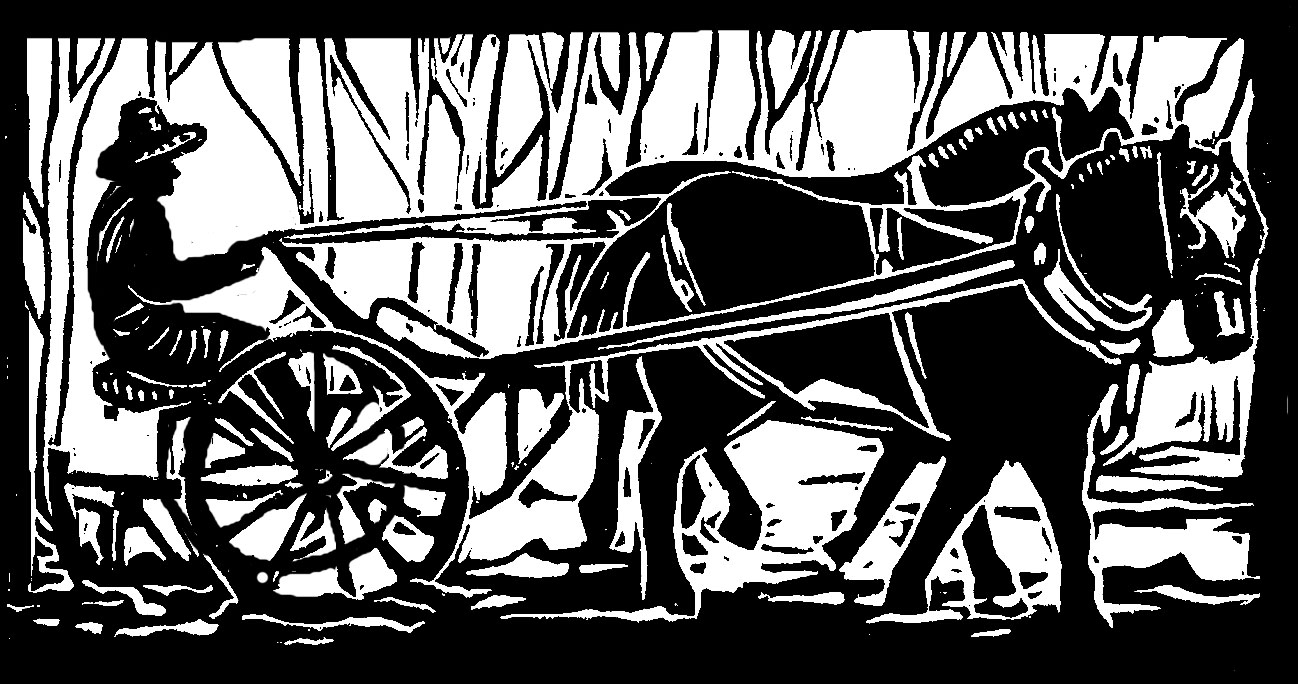
From Frantic to Pleasant: December on the Farm

It's fun to be a vegetable farmer in December, when the work goes from frantic to pleasant. Moving from a high of 14 to 16 hours of outside work a day in July to the lovely four or five hours a day in December is a very welcome change.

This is when, if it's not raining or snowing, we roll up irrigation and pull the dead stalks out of the garden beds and fix machinery: that broken foot board on the spreader, for example, which has given me fits all summer, when I saw my fellow farmer teetering his way up to the seat, using the tire and the thin metal edge of the support that should be holding an intact foot board in place.

“We have to fix this before we need the spreader again,” I would say, with great determination, but once the loads of compost were spread, we were sucked into the next whirlpool of transplanting or watering or weeding, and there we would be, the very next time with the spreader: my fellow teetering, and me worrying.

Of course, when the horses decided to go ahead just a little sooner than they should, this only compounded the problem, as the spreader lurched forward and my fellow pretty much fell on to the seat. This is much better than falling off the seat, and then falling under the spreader, which, I am very glad to report, has not happened. But it could, and I am very pleased when December comes, and we have enough time to take on this repair project.

We are also busy (well, sort of busy, four or five hours a day busy) this time of year repairing our greenhouses, replacing the hipboards and baseboards. This is in hopes that we won't have the experience of a few years ago when a big windstorm nearly took away my greenhouse and my fellow farmer, who was trying to hold the greenhouse down in the big wind. The combination of rotting hip and baseboards, a rip in the plastic, and a big wind was not a good one. Then, as hard as it is to believe, this all happened again, the next year, with the next greenhouse in the line. Perhaps we finally learned something, because this year, in spacious December, we are replacing the boards in the third and fourth greenhouses before an emergency, instead of in the middle of an emergency.

This time of year is also when, if it is raining or snowing (oh December joy! we don't have to work outside in the rain or cold whether we feel like it or not, as we must in July), we also work on the insides of the greenhouses. We unhook all those millions of little clips that held the tomatoes upright on their strings. We cut down the strings. We pull out the rows of dead plants, and pile them up to compost. We dig the beds, pull any weeds, and then add finished compost to the soil. It's a good amount of work, but it is all delightfully non-urgent this time of year, and there is the wonderful feeling that anything we do now will only help us next spring.

Anything we do now will only help us in the spring! I like that. A lot. Especially when “anything” includes paying our bills on time, and catching up on farm paperwork, and planning for next year. It includes setting our farm kitchen back to rights, and making leisurely meals, and eating those leisurely meals. It includes getting enough sleep, and taking a moonlit walk in the fields, which happens as early as 5:30 or 6 p.m. in this season, giving us plenty of time for the meal and the sleep, and the meal and the sleep are even more restful because of the walk and the moonlight in the fields.

Of course, we love that sun, that strong sun that shone on us and our vegetables and our hayfields in July, for so many hours, that in combination with rain and soil and air make our farming and all our lives possible. We love that sun all year long, warming us up in December too.

But we also love that that moon, rising over the trees, that subtler, softer light, a radiance that reminds us that night and darkness and quietness and stillness and rest and repairs are essential too, a part of the rhythm that sustains us all.

Originally published in the Monadnock Shopper News, Dec 16 – Dec 22, 2020

On Mud, Horses, Flowers, and Food, Or, the Cheshire County Conservation District Marks its 75th Year


It was early spring. All the snow had melted in the winter paddock, and the workhorses and the farmers were ankle-and-fetlock deep in mud. We all groaned.

Here came a month of feeding hay three times a day in the muck, ramming wheelbarrows of manure through the muck, pulling our boots out of the muck, pulling our horses out of the muck. Or, at least, pulling the muck out of our horses, as we groomed their itchy shedding coats, and hair and dirt came off in a cloud.

But then came the muck miracle: thanks to the Cheshire County Conservation District, which marks its 75th anniversary this year, my farmer-spouse and I were introduced to the Natural Resources Conservation Service, a federal program. The CCCD works cooperatively with the Conservation Service, weighing in on local conservation priorities, as well as serving as a conduit for interested farmers, ranchers, or foresters who would like to be part of the NRCS programs (which include funding for the historically underserved, such as socially disadvantaged, beginning, limited resource, and veteran farmers).

Thus our vegetable farm received a grant for a Heavy Use Area Protection Plan for our winter paddock, which would stabilize the ground surface, provide for water run-off, and assist in keeping the nutrients in the compost pile next to the paddock. We were pro all of those things: protecting the soil, clean water, and healthy compost.

But what we didn't expect was the pleasure of that renovated paddock: now we could all lounge about, chewing our hay, enjoying the brisk early spring air, skipping along with the wheelbarrow of manure. We could keep our boots on our feet, and our hooves dry. No more mud, no more muck, no more stuck.

In the same vein, when we two farmers were considering how to make our vegetable growing more efficient, we looked long at the ends of our garden beds, which were very close to a mature hedgerow. The big trees in the hedgerow had considerably more pulling power on the water and the nutrients than our little beds of vegetables. For years we had dutifully tilled, composted, planted, and irrigated the last 20 feet of the beds nearest the hedgerow, and for years, our vegetable harvest there was puny. But we didn't want to cut down the trees, lovely in their own right, and also home to various insect, bird, and animal lives, not to mention lichens and the like.

Then we had a brilliant idea: our vegetables don't want to grow here, but something else might. When we began working with the Cheshire County Conservation District on increasing pollinator areas, we were most pleased to sprinkle a seed mix on the ends of all those garden beds by the hedgerow. Here we were, cutting down our work load, as well as sensibly avoiding a paltry harvest. Plus, of course, we need pollinators in our gardens, to help the vegetables along, and we need pollinators (and trees) in the world, to help everything else along.

But what we didn't expect was a glory of blooming bachelor buttons in the pollinator mix. We've grown a few bachelor buttons as cutting flowers for our CSA members, but we had never sown so many, and not even realizing they were in the mix. The seeds germinated, and soon the bachelor buttons bloomed blue blue blue against brilliant green. It was like a painting, like Vincent van Gogh's irises, except it was bachelor buttons and they were right there, in our garden, blue and ablaze.

We had a beautiful paddock, a beautiful pollinator patch, and then, of course, we had all our vegetables. We were selling CSA shares and produce at the Farmers' Market in Keene, but we always want the good food to be available to a broader range of people. The CCCD stepped up again, with several programs: produce vouchers for veterans at the Farmers' Market during September, as well as the Granite State Market Match program, which doubles SNAP benefits for purchasing fresh produce, though CSA or farmers' markets. The conservation district office also worked with our group of local CSA farmers, called Farmers Helping Farmers, to create a farm share program that offered CSA shares to lower-income members of the community. Of course, we loved all this: increasing food access, food sovereignty, supporting healthy diets, and keeping local farms in business.

But what we didn't expect was the feeling that we didn't have to accomplish all of these things by ourselves. The Cheshire County Conservation District, in partnership both with federal programs such as the NRCS, and with local communities, is right there with us, working for healthy soil, clean water, abundant wildlife, and sustainable forests, farms, and gardens. Check out the CCCD at cheshireconservation.org.

Originally published in the Monadnock Shopper News, Nov 18 – Nov 22, 2020

The Three-Quarters Blues

Maybe you know that feeling: the three-quarters done feeling, the three-quarters blues. The wow, I've been doing this thing for a long time, and I'm kind of tired of it, and I'm getting grumpier and grumpier just thinking how I have to keep on.

Such as when you're washing a mountain of dishes, and you're almost to the top but not quite, and you really hate all these cruddy dishes, and your hands are all soggy, and you know if you leave the last quarter instead of finishing, the dishes will seemingly overnight become a mountain again. You keep on washing.

Or maybe you've been picking millions of cherry tomatoes for months and you really want to be done picking them, but you were a responsible farmer, and covered the row when the early frost came, and now you've still got cherry tomatoes to pick. And you think, huh, how come the flowers and beans and squash all died, but you didn't, you cherry tomatoes? But you keep on picking.

Or maybe you spent so many hours weeding this season that you think there can't possibly be any more weeds, and even though you mostly love weeding, now you can't stand it, it's been too much, too long, but your outside carrots didn't germinate well, so you tried planting some in the greenhouse, and of course, in the nice warm greenhouse, the weeds are still growing. Geez, why did you ever think you loved weeding? But you keep on weeding.

Or maybe it is like when your kitchen is full of seconds: eggplant, tomatoes, potatoes, carrots, zucchini yellow squash cucumbers broccoli tomatillos kale chard spinach, the list is endless, and it all needs to be put by for the winter. You know that in a month or six weeks your kitchen will no longer have trays full of slowly getting limper and limper vegetables, and you will be very glad for all that preserved food, but it is hard to keep that in mind when you are ¾ of the way through it all. But you keep on slicing and canning and freezing.

Or maybe it is like when you had a friend's small boy visit. Now the friend loves the farm, and she loves the boy, who is the son of her own dear friend, and the small boy immediately loves the farm. He is maybe eight years old, and this farm is the best thing he's ever seen. Then we do a little project, because this is a working visit. You decide on a fun kind of working visit job, clearing little rocks out of the greenhouse bed. The small boy thinks this is great. For quite a while.

Then, ¾ of the way through the job, he says “This is the worst day of my life! I'm going to call my mother! I'm going back home!” Back home happens to be on the West Coast, which is not too near NH. Your friend is gasping in shock at the boy hating the farm, and worried the farmer will be insulted. But you, the farmer, just laugh. You know those ¾ blues. And hey, if this is the worst day of this small boy's life, things are going pretty well. (And hey, likewise for the farmer.) With a little encouragement, we all keep on picking up those little rocks.

Of course, you'd much rather spend all afternoon in the warm sun on a blanket reading a book, especially the wonderful Braiding Sweetgrass by Robin Wall Kimmerer. Kimmerer weaves together traditional indigenous teaching and Western science, and tells of making maple syrup, both the gift of the sap, and the work of the syrup. She writes: “[the] teachings remind us that one half of the truth is that the earth endows us with great gifts, the other half is that the gift is not enough. The responsibility does not lie with the maples alone. The other half belongs to us; we participate in its transformation. It is our work, and our gratitude, that distills the sweetness” (69).

Oh all right, maybe I can be a little grateful in my grump. Because I sure do love this book, and highly recommend it, whether you are reading half the day in your backyard, or for two minutes before you fall asleep. Maybe it will even turn a ¾ grump into a full-on gratitude.

Originally published in the Monadnock Shopper News, Oct 21 – Oct 27, 2020

Breathe, Farmer, Breathe

September on the farm: oh, there's plenty to do, what with digging potatoes, and harvesting winter squash, and weeding the cabbage and broccoli, and cleaning up the garden messes we've made all season in our rush. But September also means breathing room for a farmer. Instead of Run, Farmer, Run! as in May, June, July, and August, September is time for Breathe, Farmer, Breathe.

Here are some of our deep farming breaths:

Planting: at this point, if we haven't gotten it sown or transplanted, it's pretty much too late. Ahh.

Weeding: the weeds have slowed down considerably, and we have only three garden sections in production, instead of five, as in the high season. Ahh.

Greenhouses: we still have four greenhouses going, with no empty beds, but the flush of early tomatoes and cukes and squash and basil and peppers is past, and now we have more of a steady flow, which will pretty soon be a trickle. Ahh. 

Haying: we have finished it, as of September 1st. Hooray for The End of Hay! There is not much sweeter than having a barn full of hay ready for the winter, especially considering that the later it gets in the year, the harder it is to get the hay dry. Some years we're done in June, some in July, some in August, and this year we just squeaked it in at the beginning of September and breathing time. Ahh.

Harvesting: there's an end in sight here too. It is not the relentless six full or partial days of harvesting of the high season. Why, we can even pick the summer squash and zucchini and cukes every third day now instead of every other day. The plants are getting tired, and the weather's getting cooler. Ahh.

Horsework: gee, it's easier on everybody, humans and horses alike, when it's not blazing hot. Discing under the spring sections, planting cover crops, clipping pastures: all important work, but not with the desperate summer urgency of getting the hay up before it rains. Ahh.

As I say, we've got some breathing room now on the farm. We can afford to turn our minds from the garden and the fields for a moment or two, and to consider our own breathing, and the breathing of others as well. By this I mean, specifically: George Floyd. You might wonder what the murder of George Floyd has to do with farming, and with a column on small-scale sustainable agriculture?

Well, quite a lot, as it turns out, as racism is just as insidious and pervasive in agriculture as it is in every other arena of our human lives. Currently I'm reading Leah Penniman's Farming While Black, which is both a practical guide to farming and the story of Soulfire Farm in Grafton, NY, near Albany. Soulfire Farm is a Black, Indigenous and People of Color farm that both grows food and offers numerous educational programs for farmers of color on its 80 acres.

Pennimans' book is eye-opening, and I have also been researching on the Internet. It is painful to discover how little I know about racism in agriculture. Consider the twin issues of land control and USDA farm programs, for instance: “White landowners currently control between 95 and 98% of farmland in the U.S. and nearly 100% in the Northeast, and receive over 97% of ag-related financial assistance (“The Land.” Soulfire Farm, soulfirefarm.org, 2020).

Again, “though 14% of U.S. farmland was black-owned a hundred years ago; decades of systemic discrimination and the abuse of legal loopholes has left black farmers with .52 % of the nation's arable land” (“NFU Calls for National Effort to Address Racism.” National Farmers Union E-News, nfu.org, Issue 465, June 4, 2020).

A third way of seeing the same land issue: “Black farmers lost around 90 percent of the land they owned between 1910 and 1997, while white farmers lost only about 2 percent over the same period.” Additionally, the USDA “was more than six times likely to foreclose on a black farm as it was on a white one,” and “a 2016 report from USDA shows that 86 percent of all micro loans issued between 2013 and 2015 went to white farmers, and demonstrates that at least two-thirds went to white men (Rosenberg, Nathan, and Bryce Wilson Stucki, “How USDA Distorted Data to Conceal Decades of Discrimination against Black Farmers,” The Counter, thecounter.org, Oct 26, 2019).

If that's not enough, here's another deep layer: “Between 1176 and 1187, 1.5 billion acres of land was stolen from indigenous nations in the U.S., either by executive order or treaty signed under duress. The northeast was settled prior to 1776 and is primarily unceded (a lack of treaty) territory stolen from indigenous peoples and settled without consent” (“Who We Are.” Northeast Farmers of Color, nefoclandtrust.org, 2020).

I also didn't know about Pifgford vs Glickman, a class action suit against the USDA in 1997 concerning discrimination against black farmers in the allocation of farm loans and assistance programs between 1981 and 1986. Named after North Carolina farmer Timothy Pigford (such a perfect farmer name!), this suit prompted a second case, known as Pigford II, in 2010, which provided for additional compensation to black farmers (Melvin, Jasmin. “Black farmers Win 1.25 billion in Discrimination Suit.” Reuters, reuters.com, Feb 18 2010). The Pigford cases constituted the largest civil rights settlement in history in this country.

It would be easy to get discouraged, but then I read about the Northeast Farmers of Color's land trust program, which is associated with Soulfire Farm of NY State. The Northeast Farmers of Color's land trust program claims for its vision: “to advance land sovereignty in the northeast through permanent and secure land tenure for indigenous Black, Latinx, and Asian farmers and land stewards who will use the land in a sacred manner that honors our ancestors' dreams for sustainable farming, human habitat, ceremony, native ecosystem restoration, and cultural preservation (“Who We Are.” Northeast Farmers of Color, nefoclandtrust.org, 2020).

Now this is exciting, especially since I understand that my breathing room as a farmer and a person stems in large part from the resources of my background, from my white relatives/ancestors (as well as from partaking in conservation programs with the Natural Resources Conservation Service, part of the USDA). Maybe movements like this, supporting both small-scale sustainable agriculture and people of color, is where we farmers can help each other breathe.


 Originally published in the Monadnock Shopper News, Sept 23-29, 2020