Farm Puppy

Twenty-four years ago, in the spring, we two vegetable farmers found a baby in the cabbage patch. The cabbage wasn’t nearly ready, but the baby was. 

You might think that a baby in the spring for vegetable farmers is a little crazy. Well, we soon thought so, too. Add in a new team of horses, a new greenhouse, a new venture into CSA membership, and we went from a little crazy to a lot crazy. 

Wow, we said, maybe we shouldn’t do that again. 

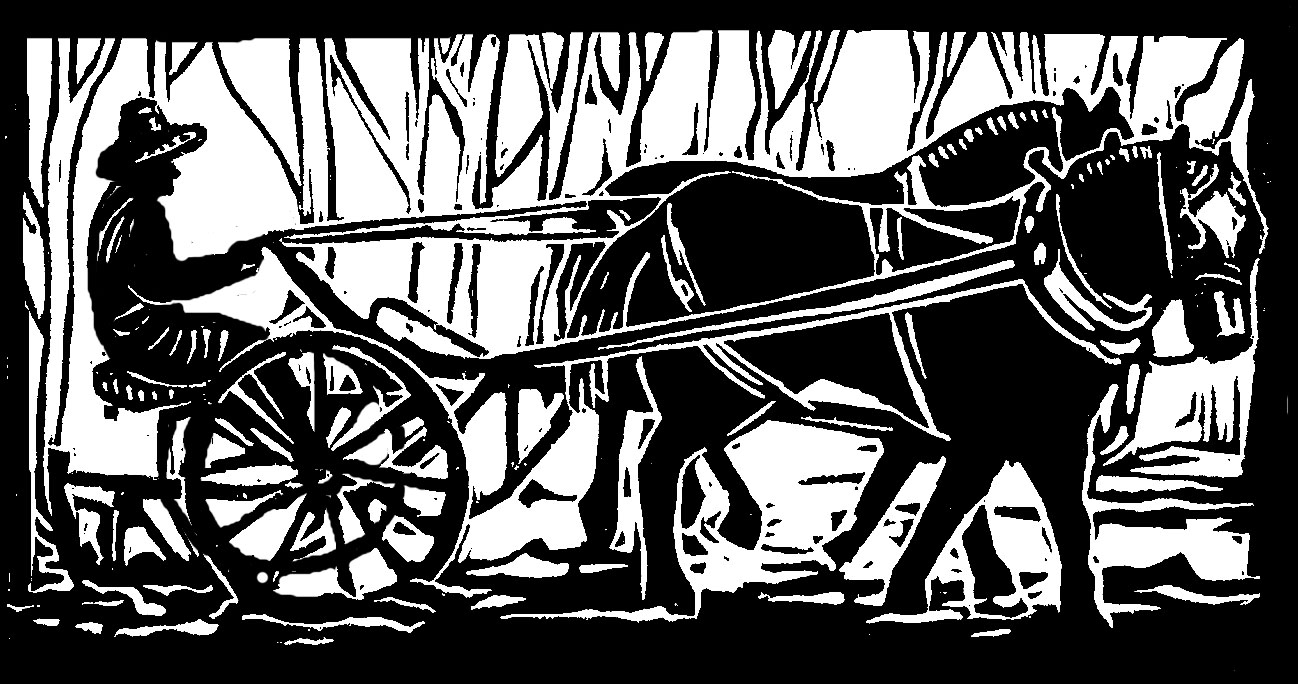
But apparently the lesson is fading. Although we don’t have a new greenhouse this year, and we are happy to be 20-plus years into CSA vegetable growing, with a full membership, we do have a new team of horses. The lovely Fern and Willow are adjusting nicely to the farm-horse life after the carriage-horse life. 

We also don’t have a new baby. But we do have a new puppy - and we are saying Wow again. Wow, you’re cute. Wow, you get up a lot in the night. Wow, it’s hard to get a lot of work done. Luckily we keep coming back to Wow, you’re cute.

Our kitty does not agree. Our kitty says Wow, the puppy is not cute. The kitty says Wow, the puppy gets up a lot in the night, and I don’t approve of this crate full of sleeping puppy in the bedroom. The kitty also says, Wow, it’s hard to get a lot of work done: I have mice to catch, and naps to take, and necessary petting, and everywhere I turn there’s a curly-haired black puppy. Wow, repeats the kitty, he really is not cute.

The horses, on the other hand, are much more interested in a puppy. 

Both our old horses and our new horses find this little being fascinating, and watch him run around. Well, they would watch him run around, but mostly he is sitting a good distance away from the horses, with his eyes big. Or he is snuggled into a farmer’s arms, wondering why an enormous creature is approaching him and making nose noises, which the farmer tells the puppy is a horse greeting, basically saying Wow, you’re cute. The puppy does not yet believe this. 

Every day we have horse therapy, cat therapy, and riding in the car is fun-not- nauseating therapy. We also have gnawing on a delicious horse hoof paring (thanks to the recent farrier visit), which gives a farmer just about enough time to water the flats of transplants in the greenhouse.

Of course, we also take many exploratory walks around the farm. Look! A stream! Look a leaf! Look! A hay rake! Look! A stick! Look! A pond! An irrigation pump! A field! A pine cone! The wonders are large and small, many and various.

We visited our vet for the first time this week, too, which the puppy thought was pretty great, especially since he got his first ever cheese whiz to lick up from the vet table. The vet is one of our long-time CSA members, and when she peeked into the room, she said, “Oh, what have you two done?” We laughed, very sleepily indeed.

The visit went well; in fact, our vet took the puppy on tour, to show him off to all the other staff in the building. When she brought him back, she said, “Well, I’ll know why if I don’t get much produce this summer!” 

We farmers laughed again, sleepily, and, I admit, a trifle nervously. Wow. A puppy. In the spring. On a vegetable farm.
 

Originally published in the Monadnock Shopper News, May 1 - May 7, 2024

All the Pretty Horses: Short and Stocky, Tall and Leggy

Not long ago, we applied for a Climate Resilience grant, saying everything that is wonderful about working with draft horses. Draft animals are an excellent source of both power and fertility, especially for a small acreage such as our farm. Draft horse work reduces soil compaction, carbon emissions, fossil fuel use, and pollution, as well as protecting species diversity (particularly amphibians), increasing soil health and capacity to hold water, and benefitting farm profitability and self-sufficiency.

Alas, we did not get the grant. But we still got the horses! (Of course, we had to use our own cash, earmarked to fix the rotting foundation of our house, to buy the horses. But hey, maybe the house will keep standing for a long time yet.)

We’ve been looking for horses for a while, and we had several leads on available teams. I was hoping for a short stocky mild team, exactly like the horses we have now, whereas my fellow was open to any kind of horses, as long as they were well-trained and could do the field work.

After two disappointing horse trips, my fellow went up to northern Maine, to visit three teams, carriage horses in Acadia National Park. It was supposed to be a two-day trip, with a knowledgeable horse teamster going along, while I stayed home to watch the greenhouse and our four horses. 

But my fellow kept sending me email messages: staying another night, so I can truck one team of horses from northern Maine to join the other two more southerly teams. Staying another night, so I don’t arrive home with new horses at midnight. Staying another night, because the truck sputtered and quit on the highway, and I want to get it fixed before I’ve got a trailer full of horses. 

Also he wrote: I’m thinking of buying the smallest team of the lot. What do you think?

Sure! I emailed back, and then I went to tell our four horses in their winter paddock about the nice small team, coming home soon. But when my fellow finally arrived on Monday afternoon with the horses, they looked mighty big.

“They’re really tall,” I said doubtfully. “I mean they’re beautiful. But they’re really tall.”

“They’re really nice,” said my fellow. “So nice you’ll think they’re short.”

“Oh, golly,” I said, “These were the smallest ones?”

“They’re leggy, but look at their little feet. The other teams had giant dinner plate feet.”

“Oh, golly,” I said.

“They’re your favorite color,” my fellow added, which was true. I love a bay horse, a rich red-brown coat with black points: mane, tail, ear edges, and lower legs. I like to call a bay horse “a horse-colored horse.” 

“They’re probably sister and brother, a mare and a gelding, 7 and 8 years old.” My fellow kept talking, as we moved our four horses from the paddock to the pasture. Our four were so ecstatic about going out on grass a month early that they didn’t even worry about the full horse trailer in the driveway. Of course, there wasn’t really much grass, and we gave them hay, but even the idea of grass is highly exciting. Plus it meant we could put the new horses in the paddock to get them used to things around the barn, without the fireworks of introducing everyone.

The new horses came off the trailer beautifully. They looked around curiously, and followed nicely up the driveway, while our four lined up at the pasture gate in astonishment and then went bucking and galloping away. The new horses were curious, but calm. They both started eating hay in the paddock, always a good sign of a relaxed horse.

I went over to the team. “I can hardly reach your backs,” I said to them, as the horses sniffed me in a friendly way.

“See?” said my fellow. “See how nice they are?”

“Fern and Willow,” I said. “Is that true? Are you so very nice? I think you must be. Welcome to your new home!”


Originally published in the Monadnock Shopper News, April 3 - April 9, 2024

Farmers and Horses: All Stirred Up

We farmers have been trying to remain calm. But we’re all stirred up, and not just because of the springy feeling in the air. It’s not just because we’re working in our greenhouses: raking beds, setting up propagation tables and heat mats, hauling in potting soil and seed packets.

No, we’re stirred up about horses. For one thing, we’ve been feeding grain all winter to our four draft horses, because they’re all at the age when a little extra in the winter helps. 

Now grain is highly exciting. It’s hard for a horse to keep calm in the face of a grain feeding, and it does a farmer good to remember the order of things: which horse to halter and bring in to the stalls first. Which horse will stand nicely next to which horse, even when grain is on the way. Which horse gets a little more grain, because they’re harder keepers, and which horse gets a little less, because they’re easy keepers.

Most important is which horse goes out of the stalls first. For instance, yesterday I brought Ben out first. He went nicely over to the hay waiting outside. Then I brought Molly out, not realizing she was going to race back in and check Ben’s grain bucket to make sure he hadn’t left any crumbs, either in the bucket or on the ground. 

Meanwhile Moon, who I hadn’t even bothered to halter, because he went into his stall on his own, decided to come out. But I was already asking Clyde to back out of his stall, and then I had to both keep Clyde in one place and try to get Moon out of the way at the same time. Finally Moon cooperated, but I had forgotten about Molly and Clyde.

Molly was sure Clyde was going to get the grain crumbs, so she started bucking and squealing, and Clyde stopped backing, and I said “Molly, for heaven’s sake!” and chased her out of the barn, while Clyde waited for me. Then I went back for Clyde, led him out, and was getting ready to take off his halter at the barn door, when Molly decided to squeeze past back into the barn.

“Molly, you turkey!” I said, letting go of Clyde, who went forward, and didn’t want to stop for me to take off his halter because now Molly was behind him. But he finally did, and pretty soon I had four horses calmly eating hay in the barnyard. 

All this is to say that grain is as exciting to horses as horses are exciting to horse farmers, which is why we farmers are all stirred up: we’re planning to buy a new team. We don’t really want to buy a new team, but our nice old horses don’t have the pep for another full garden season. 

We get pretty jazzed up on our horse trips, sure that this will be the perfect team for our little farm. So far we’ve been to Connecticut to look at a giant team of Belgians, about whom my fellow farmer said, “It makes my stomach hurt just to think of those dinner-plate hooves trying to walk down our narrow garden pathways. All those heads of lettuce going crunch crunch crunch.”

We’ve also seen a pair of black Percherons, who had the opposite effect: “It makes my stomach hurt to think of asking these two little horses to pull a full hay wagon up and down our hilly fields.” Way out in western New York State, we saw two more giant teams of Belgians, and a lovely little too-expensive pair of Belgian mares. 

Next we’re headed to Maine to see three more teams. Maybe one of these will be the perfect team for us! Meanwhile we visit our four perfect grain-loving horses in the barnyard, wishing they were a little younger, and reminding ourselves of just what kind of horses we’d like to have come live and work with us.


Originally published in the Monadnock Shopper News, March 6-March 12, 2024

A Pleasant, Peculiar People

Recently we farmers hosted a birding event. We prepared by reading our bird notebook, with its twenty years of birds we’ve identified here on the farm. Plus there are records of early frosts, and July hail, and lots of animal sightings.

“Remember the loon flying overhead?” we said. “Remember the bobcat? Remember the first time we saw the pileated woodpecker? Remember the bear, and the moose? Remember the yellow-rumped myrtle warbler by the pond?” 

We are amateur birders at best, but we had a pretty good list to read to our visitors, in case there weren’t any real birds out and about at the end of January. Plus we had our mammal and amphibian lists: even more diversion for birders not seeing birds.

The event, sponsored by the Cheshire and Windham County Conservation Districts, attracted a good group. We had the farmers, the conservationists, and experienced and brand-new birders, coming from Vermont and New Hampshire.

Now birders are a pleasant, interested, interesting people. Individually, they are eager to tell you their birding stories and to listen to your farm stories. Collectively, they are a bit more peculiar. 

But we had been warned: in the middle of the most fascinating remarks on small sustainable farming and its wonderful effects on bird populations and diversity, suddenly one birder would point at the sky, and the whole group would swing up their binoculars and turn as one to gaze at a tiny flying speck. Then there would be a long pregnant pause, followed by a spirited discussion of the speck. Then the crowd would turn smiling back to the farmer or conservationist that had been mid-speech.

There was only one point during the tour that there were no arms pointing or binoculars lifted. That was when we visited four really big birds in the barnyard: four draft horses, two of which ambled over for petting, and two of which kept eating their morning hay.

After we talked about our nice horses and our nice heavy use protection area grant in the barnyard, we went on to the garden. Suddenly the birders were all a-twitter! There were red crossbills, calling and flying! The farmers were all a-twitter too: we had never seen or knowingly heard a crossbill on our farm!

There was an evening grosbeak on top of a pine tree, a beautiful golden bird that sometimes visits our bird feeder, and who was a first for some of the birders. There were two red-tailed hawks. There were purple finches, New Hampshire’s state bird. By then some of the birders were in bird-list bliss.

At each stopping point we farmers told a bird story: the red-tailed hawk that had gotten caught in our former mesh garden fence, and how glad we were to set it free, and how glad we were for another conservation grant that allowed us to put up a metal fence that didn’t catch birds. All the birders nodded happily. 

We talked about how birds benefit from the farm’s crop diversity, mulch, cover-crops, and low-till agriculture. We mentioned the tree swallows’ lovely liquid call as they swoop around our garden catching bugs. We pointed to all the wild, bird-friendly edges of the garden. 

We went on to the pond, the mushroom yard, and the fields, where the birders showed their mammal mettle by identifying possum, rabbit, and deer tracks. We talked about pasture conservation projects, and one birder said maybe we could see flocks of nightjars migrating if we stood on the edge of our biggest field at dusk in September. 

We liked that idea, especially since the only nightjar we’ve heard on our farm was identified by a visitor. We’re not even sure that hearing a bird counts for your bird list, but as I say, we are amateur birders, so we’ll take everything we can get. That day we got 18 different species, and we got a nice bunch of birders on a warmish day in January, loving birds and loving farms.
 

Originally published in the Monadnock Shopper News, Feb 7 - Feb 13, 2024